
Sin did not begin on the earth first; it began in the unseen realm, in the heart of a created being who turned his glory into pride. Before Adam and Eve stretched out his hand toward the forbidden fruit, before Eve listened to the serpent, rebellion had already entered creation through the one called “morning star,” who exalted himself against God. The first sin was not murder, adultery, stealing, or lying with the tongue; the first sin was the inward rising of pride against the throne of God. Sin begins in the heart before it appears in action. It begins when the created being forgets that all beauty, wisdom, authority, and glory are received from the Creator.
The Bible reveals that God is a God of order. He established heavenly order among angelic beings, and He established earthly order in the family. When that order was despised, sin entered. The morning star rebelled against God’s supreme headship. Adam failed to walk in the responsibility of godly headship entrusted to him. Eve acted independently of that order, receiving the serpent’s voice above the command of God and the covering of her husband. These first sins reveal the pattern of all later sin: pride, passivity, deception, disorder, and independence from God. But the New Covenant reveals a better Adam, Jesus Christ, who restores what was lost through obedience, humility, truth, and sacrificial love.
1. The First Sin: The Morning Star Exalting Himself Against God
The first sin of the universe was the sin of prideful self-exaltation. Isaiah 14:12–14 gives a prophetic picture of this fall: “How you are fallen from heaven, O Lucifer, son of the morning! How you are cut down to the ground, you who weakened the nations! For you have said in your heart: ‘I will ascend into heaven, I will exalt my throne above the stars of God… I will be like the Most High’”. Ezekiel 28:15 also speaks of one who was once full of beauty and wisdom but became corrupted: “You were perfect in your ways from the day you were created, till iniquity was found in you”. Again it says, “Your heart was lifted up because of your beauty; you corrupted your wisdom for the sake of your splendor” (Ezekiel 28:17). Jesus Himself said, “I saw Satan fall like lightning from heaven” (Luke 10:18). These verses show that sin was born when a created being looked at what God had given and tried to possess glory apart from God.
The morning star did not begin as darkness; he became darkness by turning away from light. His sin was not weakness, but arrogance. He did not lack position; he rejected his assigned place. He did not lack beauty; he became proud because of beauty. He did not lack wisdom; he corrupted wisdom by using it for self-glory. His repeated declaration was “I will.” This is the voice of sin: “I will ascend, I will exalt, I will be like the Most High.” Pride does not always begin by denying God’s existence; sometimes it begins by wanting God’s throne. Pride says, “I want authority without submission, glory without worship, power without obedience, and independence without accountability.” The first sin teaches us that the creature is safest only when he remains surrendered to the Creator.
Under the New Covenant, believers must understand that pride is not a small weakness. Pride is the root of rebellion. The apostle Paul warns that a spiritual leader must not be a novice, “lest being puffed up with pride he fall into the same condemnation as the devil” (1 Timothy 3:6). James declares, “God resists the proud, but gives grace to the humble” (James 4:6). Peter repeats the same truth: “Clothe yourselves with humility toward one another, because God opposes the proud but shows favor to the humble” (1 Peter 5:5). Pride places a person in opposition to God, not because God is unwilling to love, but because pride refuses to receive grace. Grace can only be received by the humble heart. The proud heart argues, competes, justifies itself, compares itself, and seeks its own name. The humble heart bows, repents, listens, obeys, and gives glory back to God.
Jesus Christ is the complete opposite of the fallen morning star. Satan said, “I will ascend,” but Jesus “humbled Himself and became obedient to the point of death, even the death of the cross” (Philippians 2:8). Satan desired to grasp equality with God in rebellion, but Christ, though being in the form of God, did not use His glory for selfish display. Satan lifted himself upward and was cast down. Christ humbled Himself downward and was highly exalted by the Father. This is the New Covenant pattern: the way up is down, the way to life is death to self, and the way to glory is humble obedience. The believer must daily reject the spirit that says, “I will rule my own life,” and must instead pray, “Father, not my will, but Yours be done.”
2. The Second Sin: Adam Failing in Godly Headship and Responsibility
The second sin revealed in the Bible is Adam’s failure to guard, lead, instruct, and stand in the responsibility God had given him. Before Eve was formed, God gave the command directly to Adam (Eve had not yet been created then): “Of every tree of the garden you may freely eat; but of the tree of the knowledge of good and evil you shall not eat” (Genesis 2:16–17). God placed Adam in the garden “to tend and keep it” (Genesis 2:15). This means Adam was not only a worker but also a guardian. After Eve was deceived and ate, Scripture says, “She also gave to her husband with her, and he ate” (Genesis 3:6). This phrase is serious because it shows Adam was not far away from the event. He was present, yet silent. He heard enough, saw enough, and knew enough, but he failed to rise up in obedience, speak the truth, and protect the command of God; this was the sin of omission.
Adam’s sin was not only in eating the fruit; before he ate, he had already failed in responsibility. He failed to guard the command of God. He failed to confront the serpent. He failed to remind Eve of God’s word. He failed to stand as the responsible head of the family. Adam had received the commandment directly from God and therefore bore headship accountability. He was responsible before God for his own obedience and for the spiritual care and protection of his wife. This is why, after the fall, the LORD God called to Adam — not Eve — and said, “Where are you?” (Genesis 3:9).
Adam failed to love his wife by protecting her from deception. True headship is not domination; true headship is responsibility before God. He was called to cover his wife with care, guide her in truth, serve her in love, protect her from deception, and lead her in obedience to God. When the serpent spoke, Adam should have answered with the word of God. When confusion entered, he should have brought clarity. When deception came near, he should have guarded the one entrusted to him. But instead of standing in obedience, he remained passive; and passivity in the face of spiritual danger is also sin.
The New Testament places responsibility on Adam in a very direct way. Paul writes, “Through one man sin entered the world, and death through sin” (Romans 5:12). Again he says, “By one man’s disobedience many were made sinners” (Romans 5:19). Adam stood as the covenant representative, yet he failed to lead, guard, and protect the family entrusted to him; and through his disobedience, sin entered humanity. Paul also writes, “Adam was not deceived, but the woman being deceived, fell into transgression” (1 Timothy 2:14). This shows Adam’s sin had a grave moral responsibility because he sinned with responsibility and knowledge. He was not simply tricked in the same way. He chose disobedience while knowing the command. That is why Scripture identifies Christ as the last Adam: “The first man Adam became a living being. The last Adam became a life-giving spirit” (1 Corinthians 15:45). The failure of the first Adam is answered by the obedience of Christ.
In the New Covenant, every husband, father, elder, pastor, and spiritual leader must learn from Adam’s failure. Leadership is not a title to enjoy but a burden to carry. A husband is called to love his wife “just as Christ also loved the church and gave Himself for her” (Ephesians 5:25). Christlike headship does not crush; it sacrifices. It does not demand honor while refusing responsibility. It does not remain silent while the family is spiritually attacked. A godly head must lead by word, prayer, example, humility, correction, and love. Adam blamed Eve after the fall, saying, “The woman whom You gave to be with me, she gave me of the tree, and I ate” (Genesis 3:12). This is another sign of fallen headship: instead of repentance, he shifted blame. But Christ did the opposite. Jesus did not blame His bride; He took responsibility for her redemption. Adam stood beside his bride and entered sin with her; Christ stood in the place of His bride and bore sin for her. Therefore, the New Covenant man must not imitate passive Adam, but sacrificial Christ.
3. The Third Sin: Eve Acting Independently from God’s Word and God’s Order
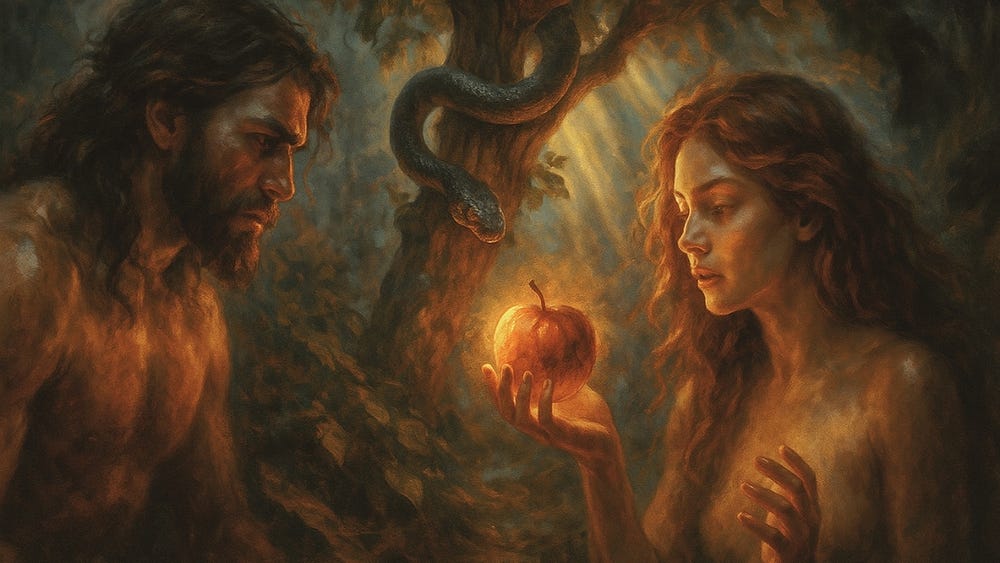
The third sin in the biblical account is Eve’s independent decision to receive the serpent’s word and eat from the forbidden tree. Genesis says, “Now the serpent was more cunning than any beast of the field which the LORD God had made. And he said to the woman, ‘Has God indeed said, You shall not eat of every tree of the garden?’” (Genesis 3:1). The serpent began by questioning God’s word. Eve answered, but her answer shows the conversation had already moved into dangerous territory. The serpent then directly contradicted God: “You will not surely die” (Genesis 3:4). Then he added temptation through desire: “You will be like God, knowing good and evil” (Genesis 3:5). Eve looked, desired, took, ate, and gave to Adam.
Eve’s sin was not merely eating fruit; it was listening to a voice that opposed God. She allowed the serpent to reinterpret God’s command. She received counsel from the enemy without returning to God’s word. She acted on desire instead of obedience. She made a decision that affected her husband, her family, and all humanity. The Bible says, “When the woman saw that the tree was good for food, that it was pleasant to the eyes, and a tree desirable to make one wise, she took of its fruit and ate” (Genesis 3:6). This pattern is still alive today: the lust of the flesh, the lust of the eyes, and the pride of life. John warns, “For all that is in the world — the lust of the flesh, the lust of the eyes, and the pride of life — is not of the Father but is of the world” (1 John 2:16). Eve saw the fruit as good, pleasant, and desirable for wisdom. But what appears good outside God’s command becomes death.
This does not mean Eve alone is blamed for the fall, because Scripture clearly holds Adam responsible as the covenant head. Yet Eve’s action still reveals a serious spiritual lesson. She stepped outside the safety of God’s word and God’s order. Instead of standing firmly on God’s command, Eve yielded to the serpent’s “new information,” allowed it to rise above God’s word in her mind, and acted independently without seeking counsel from Adam, who bore responsibility as the head of the family. This is one of the oldest tactics of the enemy. Satan rarely begins by asking people to openly hate God. He begins by making them question God’s goodness, God’s command, God’s authority, and God’s truth. He whispers, “Maybe God is withholding something from you.” He suggests, “Maybe your own wisdom is better.” He says, “Maybe you can decide good and evil for yourself.” Once the soul accepts this lie, disobedience becomes easier.
Under the New Covenant, believers must learn to test every voice by the word of God. Jesus said, “My sheep hear My voice, and I know them, and they follow Me” (John 10:27). Paul warns, “I fear, lest somehow, as the serpent deceived Eve by his craftiness, so your minds may be corrupted from the simplicity that is in Christ” (2 Corinthians 11:3). This means the danger of Eve’s deception is not only ancient history; it is a present warning to the Church. The mind can still be corrupted from simple devotion to Christ. The serpent still speaks through false teaching, worldly wisdom, emotional pressure, ungodly counsel, prideful independence, and spiritual confusion. Therefore, every believer must ask: “Whose voice am I receiving? Whose word am I obeying? Who is shaping my decision?” In Christ, we are not called to live by independent self-rule. We are called to live by the Spirit, under the Lordship of Jesus, in submission to the word of God.
4. The New Covenant Answer: Christ Restores What Pride, Passivity, and Deception Destroyed
The first three sins reveal three deep wounds in creation: the morning star reveals the wound of pride against God; Adam reveals the wound of passive and disobedient headship; and Eve reveals the wound of deception, where independent decision-making operated outside the appointed headship. But the gospel reveals Jesus Christ as the complete answer to all three. Where Satan exalted himself, Christ humbled Himself. Where Adam failed to guard his bride, Christ gave Himself for His bride. Where Eve received the serpent’s word, Christ defeated Satan by speaking, “It is written” (Matthew 4:4, 4:7, 4:10). Jesus did in the wilderness what Adam and Eve failed to do in the garden. He refused the devil’s interpretation. He refused the temptation of appetite, display, and worldly glory. He obeyed the Father completely.
Romans 5 gives the New Covenant victory clearly: “For as by one man’s disobedience many were made sinners, so also by one Man’s obedience many will be made righteous” (Romans 5:19). This is our hope. The answer to the sins is not merely moral improvement; it is union with Christ. We must be born again. We must receive the Spirit of Christ. We must allow the cross to kill pride, selfish independence, and blame-shifting. We must allow the Spirit to form humility, obedience, truth, and sacrificial love in us. The New Covenant is not only forgiveness from sin; it is deliverance from the nature of sin. God writes His law on our hearts, teaches us His ways, and makes us new from within.
Conclusion: Returning to God’s Order Through Christ
The first three sins of the Bible are not merely ancient events; they are mirrors of the human heart. Pride still declares, “I will exalt myself.” Passivity still refuses responsibility, remains silent when truth must be spoken, and then accuses others for the wrongs around us; this is the sin of omission. Deception still listens to the serpent when God has already spoken, rejecting God’s command and stepping outside the appointed headship established for protection and order. These sins continue to destroy individuals, marriages, families, churches, and nations. But Jesus Christ came to destroy the works of the devil, restore the broken order of creation, and bring many sons and daughters into obedience to the Father.
Prayer: Father, in the name of Jesus Christ, deliver us from the pride that first corrupted the created heart. Deliver us from the silence, passivity, and blame-shifting of Adam. Deliver us from the deception that led Eve away from Your command, outside Your appointed order, and into independent decision-making apart from Your word. Teach us to honor Your order, love Your word, and walk in humility before You. Make our homes holy, our decisions pure, our hearts obedient, and our lives surrendered. Let Christ be formed in us. Let the mind of Christ rule us. Let the Holy Spirit guide us into all truth. In Jesus’ name, Amen.