
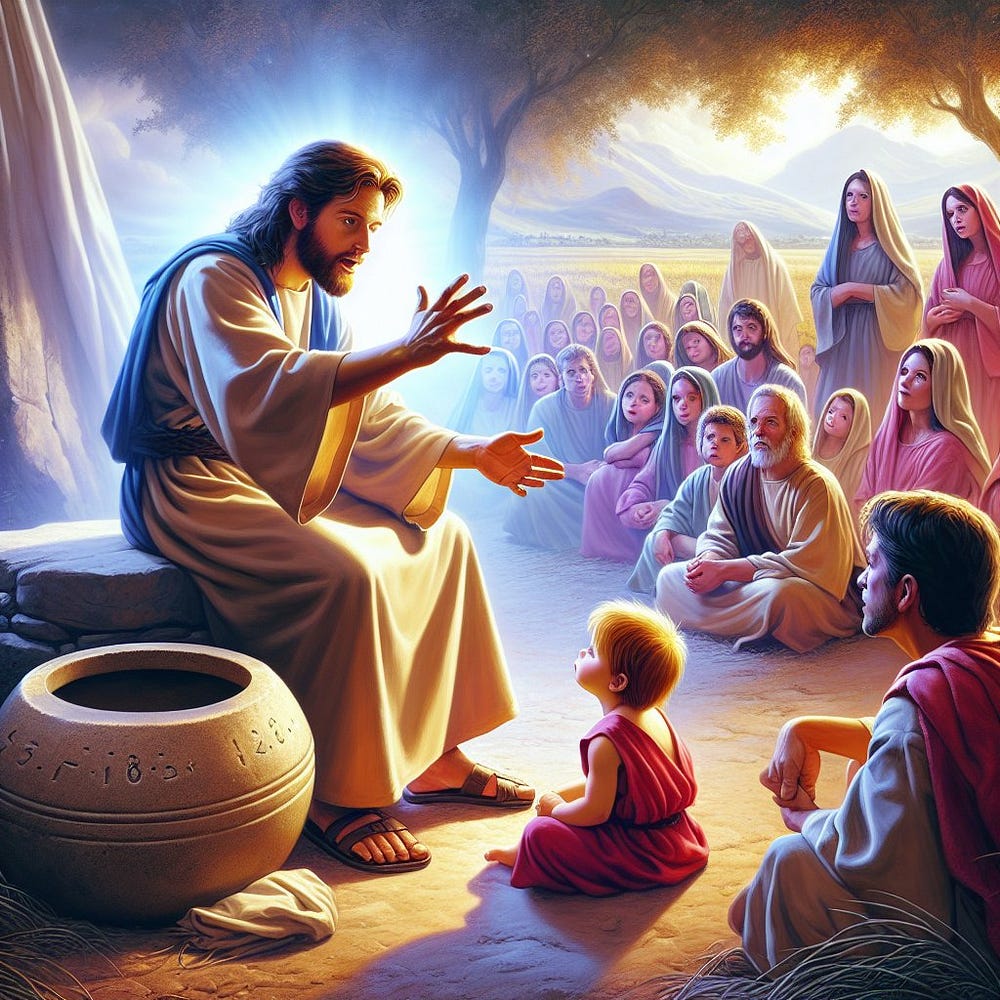
Jesus said, “Unless you are converted and become as little children, you will by no means enter the kingdom of heaven” (Matthew 18:3).
He also said, “Whoever humbles himself as this little child is the greatest in the kingdom of heaven” (Matthew 18:4).
Again, Jesus said, “Let the little children come to Me, and do not forbid them; for of such is the kingdom of God” (Mark 10:14).
And He added, “Assuredly, I say to you, whoever does not receive the kingdom of God as a little child will by no means enter it” (Mark 10:15).
The kingdom of heaven is not entered by religious pride, human greatness, self-confidence, or worldly ambition. It is entered through repentance, humility, faith, purity, dependence, and surrender. A child does not come with titles, achievements, arguments, or self-righteousness. A child comes empty, trusting, dependent, and teachable. This is the heart Jesus requires from everyone who desires to enter His kingdom. The Lord is not calling believers to be childish in understanding, but childlike in heart. Paul says, “Do not be children in understanding; however, in malice be babes, but in understanding be mature” (1 Corinthians 14:20). Therefore, the New Covenant believer must be mature in truth, yet simple in faith. He must be wise concerning good, but innocent concerning evil.
1. A Childlike Heart Has No Pride
A little child does not think highly of himself. He does not stand before his father and mother claiming greatness, power, status, or superiority. He does not compare his house, clothing, food, or position with others in a proud and ambitious way. This is why Jesus placed a child in the midst of His disciples when they asked, “Who then is greatest in the kingdom of heaven?” (Matthew 18:1). The disciples were thinking about position, but Jesus showed them humility. The world teaches people to climb higher, speak louder, promote themselves, and prove themselves. But Jesus teaches His people to go lower. Scripture says, “God resists the proud, but gives grace to the humble” (James 4:6). Pride blocks grace because pride says, “I am enough.” Humility receives grace because humility says, “Lord, without You I am nothing.” The kingdom of heaven is not given to those who exalt themselves, but to those who bow before God.
The childlike believer does not boast in himself, his wisdom, his ministry, his wealth, his holiness, or his sacrifices. He understands that everything he has is received from God. Paul asks, “What do you have that you did not receive?” (1 Corinthians 4:7). If everything is received, then there is no reason to boast as though it came from ourselves. Jesus said, “Whoever exalts himself will be humbled, and he who humbles himself will be exalted” (Matthew 23:12). This is the opposite of the spirit of the world. The proud man wants people to recognize him. The humble man wants Christ to be glorified. The proud man wants to be served. The childlike man is willing to serve. In the New Covenant, greatness is not measured by self-exaltation, but by humility, obedience, and surrender to God.
2. A Childlike Heart Is Not Controlled by Praise or Criticism
A small child is not ruled by public opinion. If someone criticizes him, he does not build his whole identity upon that insult. If someone praises him, he does not become proud and worship himself. Adults are often wounded by criticism and intoxicated by praise. They carry insults for many years and replay the words of people in their minds. They also become proud when people appreciate them, honor them, or exalt them. But the childlike believer must learn to live before the face of God, not before the applause or rejection of men. Paul said, “With me it is a very small thing that I should be judged by you or by a human court” (1 Corinthians 4:3). He also said, “He who judges me is the Lord” (1 Corinthians 4:4). This is freedom. When God becomes the judge of our life, human praise and human criticism lose their power over us.
Jesus Himself lived this way. People praised Him, but He did not become proud. People accused Him, but He did not become bitter. Scripture says, “When He was reviled, He did not revile in return; when He suffered, He did not threaten” (1 Peter 2:23). He entrusted Himself to the Father who judges righteously. This is the spirit of a child of God. A childlike believer does not live by ego, reputation, image, and human approval. He does not need everyone to praise him. He does not collapse when someone criticizes him. He knows his Father sees him. He knows his Father loves him. He knows his Father will correct him when correction is needed. He knows his Father will defend him when defense is needed. Therefore, he does not fight every accusation, answer every insult, or chase every compliment. He rests in the Father.
3. A Childlike Heart Is Free from the Lust of the Eyes and the Flesh
A little child is content with what is given. He eats what is provided, wears what is given, sleeps where he is placed, and lives within the care of his father. He does not spend his days planning luxury, status, pleasure, and worldly increase. But as people grow, the lust of the flesh, the lust of the eyes, and the pride of life begin to rule them. Scripture warns, “Do not love the world or the things in the world” (1 John 2:15). It also says, “For all that is in the world — the lust of the flesh, the lust of the eyes, and the pride of life — is not of the Father but is of the world” (1 John 2:16). These desires corrupt the simplicity of the heart. They make people restless. They make people compare, covet, envy, and complain. They make people pray not for holiness, but for luxury. They make people seek God not as Father, but as a supplier of worldly pride.
The New Covenant believer must return to holy simplicity. Paul said, “Having food and clothing, with these we shall be content” (1 Timothy 6:8). He also warned, “Those who desire to be rich fall into temptation and a snare” (1 Timothy 6:9). This does not mean that God cannot bless His children with material things. But it means the heart must not be possessed by them. A child cries when hungry, sick, cold, or uncovered, because these are true needs of the body. But the worldly heart cries for bigger houses, finer clothes, better cars, more money, expensive devices, and human admiration. Many prayers are not cries of need, but cries of lust. James says, “You ask and do not receive, because you ask amiss, that you may spend it on your pleasures” (James 4:3). A childlike heart asks the Father for daily bread, not daily pride. Jesus taught us to pray, “Give us this day our daily bread” (Matthew 6:11). This is the prayer of dependence, contentment, and trust.
4. A Childlike Heart Does Not Worry About Tomorrow
A little child does not wake up thinking about next year’s rent, next month’s food, or tomorrow’s journey. He depends on his parents. He does not know all the plans, but he trusts the one holding his hand. This is exactly the attitude Jesus calls His disciples to have toward the heavenly Father. Jesus said, “Do not worry about your life, what you will eat or what you will drink; nor about your body, what you will put on” (Matthew 6:25). He also said, “Your heavenly Father knows that you need all these things” (Matthew 6:32). The Father knows before the child asks. The Father sees before the child understands. The Father provides before the child can manage. Worry is often a sign that the heart has forgotten the Father. Anxiety grows when we think the future depends entirely on our own strength.
Jesus gave the cure for worry: “Seek first the kingdom of God and His righteousness, and all these things shall be added to you” (Matthew 6:33). The child of God is not called to seek first money, security, comfort, promotion, or recognition. He is called to seek the kingdom. He is called to seek righteousness. He is called to trust the Father for what is needed. Jesus also said, “Do not worry about tomorrow, for tomorrow will worry about its own things” (Matthew 6:34). This does not mean laziness or irresponsibility. It means freedom from unbelieving anxiety. The believer works faithfully today, obeys God today, prays today, and trusts God for tomorrow. Like a child walking with his father, he may not know the full destination, but he knows the hand that leads him. Faith does not need to see the whole road. Faith only needs to know the Father is faithful.
5. A Childlike Heart Trusts the Father Completely
A child goes with his parents without understanding every detail of the journey. He may not know the road, the distance, the danger, the cost, or the destination. Yet he sits in the vehicle because he trusts the driver. This is a picture of faith. Abraham obeyed God in this way. Scripture says, “By faith Abraham obeyed when he was called to go out to the place which he would receive as an inheritance” (Hebrews 11:8). It also says, “He went out, not knowing where he was going” (Hebrews 11:8). Abraham did not have a full map, but he had the word of God. That was enough. The childlike believer does not demand that God explain everything before he obeys. He trusts the character of God. He follows the voice of God. He believes that the Father’s will is safer than his own understanding.
Proverbs says, “Trust in the Lord with all your heart, and lean not on your own understanding” (Proverbs 3:5). This is childlike faith. The child of God must not lean on fear, logic, emotion, experience, or human advice above the word of the Father. He must acknowledge God in all his ways, and God will direct his paths. Jesus said, “My sheep hear My voice, and I know them, and they follow Me” (John 10:27). The sheep does not lead the Shepherd. The child does not command the Father. The servant does not instruct the Master. The believer follows Christ. Even when the journey is unknown, the destination is secure because the Father is faithful. The childlike heart says, “Lord, I do not know everything, but I know You. I do not understand everything, but I trust You. I do not see tomorrow, but You are already there.”
6. A Childlike Heart Is Innocent Concerning Evil
A child does not commit murder nor adultery. A child does not live by hatred, revenge, lust, manipulation, and accusation. This innocence is precious before God. Jesus said, “Blessed are the pure in heart, for they shall see God” (Matthew 5:8). Purity is not only outward behavior; it is the condition of the inner man. In the New Covenant, Jesus goes deeper than the old outward commandment. He said, “Whoever is angry with his brother without a cause shall be in danger of the judgment” (Matthew 5:22). He also said, “Whoever looks at a woman to lust for her has already committed adultery with her in his heart” (Matthew 5:28). Therefore, murder begins in hatred, and adultery begins in lust. The childlike believer must guard the heart, not merely the hands.
The New Covenant does not produce outward religious people with inward corruption. It produces new hearts by the Holy Spirit. God promised, “I will put My laws in their mind and write them on their hearts” (Hebrews 8:10). This means the believer does not merely avoid sin because of fear of punishment. He hates sin because God has changed his heart. He does not desire to murder because love has been poured into his heart. He does not desire adultery because his body is the temple of the Holy Spirit. Paul says, “Flee sexual immorality” (1 Corinthians 6:18). He also says, “You were bought at a price; therefore glorify God in your body and in your spirit, which are God’s” (1 Corinthians 6:20). A childlike heart belongs to the Father. It does not use the body for lust, the tongue for accusation, the mind for pride, or the hands for violence. It seeks to be clean before God.
7. A Childlike Heart Does Not Judge, Complain, or Accuse
Adults often judge, accuse, complain, compare, and condemn. They keep records of wrongs. They speak against others. They magnify faults. They become like prosecutors instead of children of the Father. Jesus said, “Judge not, that you be not judged” (Matthew 7:1). He also said, “Why do you look at the speck in your brother’s eye, but do not consider the plank in your own eye?” (Matthew 7:3). The proud heart sees everyone else’s sin clearly but remains blind to its own. The childlike heart is quick to repent and slow to condemn. It does not deny truth, but it refuses self-righteous judgment.
Paul says, “Do all things without complaining and disputing” (Philippians 2:14). Complaining is the language of unbelief. Israel complained in the wilderness because they forgot the goodness of God. They saw manna, but wanted Egypt. They saw miracles, but spoke against Moses. They were delivered from slavery, but still murmured against God. The same danger exists today. Many believers are saved by grace, fed by mercy, protected by God, and still complain because life is not according to their desire. A childlike believer learns to receive from the Father with thanksgiving. He does not accuse God when prayers are delayed. He does not judge others when they are weak. He does not complain when the Father trains him through hardship. He remembers that the Father disciplines those He loves. He says with faith, “The Lord gave, and the Lord has taken away; blessed be the name of the Lord” (Job 1:21).
8. A Childlike Prayer Seeks True Needs, Not Worldly Pride
A child cries when hungry, sick, cold, or without sufficient covering. These cries are connected to real need. In the same way, the child of God should bring real needs before the Father. Jesus taught us not to pray like worldly people seeking display, but to pray simply before the Father. He said, “Your Father knows the things you have need of before you ask Him” (Matthew 6:8). He taught us to pray for daily bread, forgiveness, deliverance from evil, and the Father’s will. This prayer is pure. It is not driven by greed. It is not driven by competition. It is not driven by the desire to appear greater than others. It is the prayer of a child who depends on the Father for life, holiness, mercy, and protection.
This does not mean believers cannot ask God for help in earthly matters. But the heart must be examined. Are we praying for need, or are we praying for pride? Are we asking for provision, or are we asking for status? Are we seeking the kingdom, or are we seeking luxury? Paul says, “Godliness with contentment is great gain” (1 Timothy 6:6). The childlike believer is content because he knows the Father. He may have little, but he is not abandoned. He may suffer, but he is not forgotten. He may wait, but he is not rejected. He may lack luxury, but he will not lack grace. David said, “The Lord is my shepherd; I shall not want” (Psalm 23:1). This is the confession of a childlike heart. The Father is enough. The Shepherd is enough. Christ is enough.
Conclusion: Become Like a Child Before the Father
Jesus did not say that childlike humility is optional. He said, “Unless you are converted and become as little children, you will by no means enter the kingdom of heaven” (Matthew 18:3). This is a serious word. The kingdom is not entered by pride, lust, anxiety, hatred, adultery, judgment, complaint, or worldly ambition. The kingdom is received by humble, dependent, trusting, pure, and surrendered hearts. Therefore, let every believer come down from self-exaltation and return to the Father with the heart of a child. Let us say, “Holy Spirit God, I need You, teach me, lead me, cleanse me, provide what I truly need, remove pride, lust, worry, judgment, and complaint from my heart. Make me humble, pure, trusting, and content before You. Teach me not to worry about tomorrow, but to seek Your kingdom and Your righteousness. Help me to trust You even when I do not know the journey. Help me to hear You, follow You even when I do not understand the destination. Fill me with Your power, and make me worthy of Your kingdom. Amen.”