
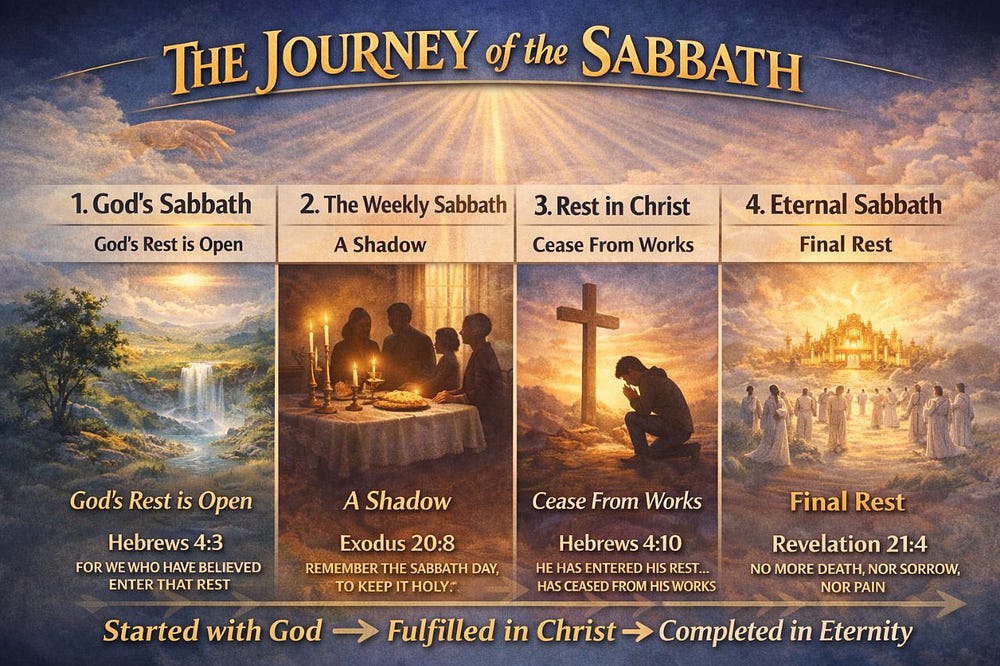
The Sabbath begins not merely as a Jewish custom, but as a divine pattern established by God Himself in creation. Genesis 2:2–3 says, “And on the seventh day God ended His work which He had made; and He rested on the seventh day from all His work which He had made. And God blessed the seventh day, and sanctified it.” Before there was Israel, before there was Moses, before there was Sinai, God set apart the seventh day as holy. The Sabbath was not created because God was tired, for the Creator does not faint or grow weary. Rather, God rested to establish a sacred rhythm for His creation. The six days of work and the seventh day of rest reveal that human life was never meant to be driven only by labor, gain, survival, and earthly ambition. Man was created to work under God, rest in God, and remember God. The Sabbath teaches that time itself belongs to the Lord. When God blessed the seventh day, He placed divine meaning upon rest. When God sanctified it, He separated it from ordinary days. Therefore, Sabbath in Torah is not merely a day off; it is a holy sign that life must return to God. It reminds man that he is not a machine, not a slave to production, and not the owner of his own breath. Every seventh day, creation itself preached that God is Creator, Sustainer, Provider, and Lord.
When God later gave the Sabbath command to Israel, He connected it to His creation order and covenant command. Exodus 20:8–11 says, “Remember the sabbath day, to keep it holy… For in six days the LORD made heaven and earth, the sea, and all that in them is, and rested the seventh day.” Israel was commanded not merely to remember the day, but to keep it holy. This means the Sabbath was not to be treated as common time, self-centered time, business time, or pleasure-seeking time. It was time consecrated to God. The commandment called Israel to stop their ordinary labor and acknowledge that the Lord who created all things was also the Lord who provided for them. Sabbath was a weekly confession of faith. By resting, Israel declared that their survival did not depend only on their own hands. By stopping, they proclaimed that God could sustain them even when they ceased from work. By honoring the day, they admitted that the rhythm of life must be governed by God’s word. The Sabbath was also a mercy from God, because servants, strangers, animals, sons, daughters, and households were all brought under its blessing. God did not want rest only for the powerful. He commanded rest for the weak, the poor, the foreigner, and even the beasts of burden.
Mosaic Law: Rules and Regulations Given to Israel
Under the Mosaic Law, the Sabbath became a covenant sign between God and Israel. Exodus 31:13 says, “You shall surely observe My sabbaths; for this is a sign between Me and you throughout your generations” The Sabbath was not merely a private spiritual discipline; it was a national covenant marker. It identified Israel as a people separated unto the Lord. Exodus 31:16–17 further says, “Wherefore the children of Israel shall keep the sabbath… for a perpetual covenant. It is a sign between me and the children of Israel for ever.” This shows that the Sabbath, in its Mosaic legal form, was especially given to Israel as part of the Sinai covenant. The nations were not brought under the same covenant arrangement as Israel at Sinai. Israel was redeemed from Egypt, brought through the wilderness, and placed under the Law of Moses. Therefore, the Sabbath command in Mosaic Law carried legal obligations, covenant identity, and national responsibility. It reminded Israel that they belonged to YHWH and not to Pharaoh. Once they had been slaves under Egypt’s harsh labor, but now they were servants of the living God. The Sabbath declared freedom from slavery and submission to God’s rule. Deuteronomy 5:15 says, “ You shall remember that you were a slave in the land of Egypt, and the Lord your God brought you out of there by a mighty hand and by an outstretched arm; therefore the Lord your God commanded you to observe the sabbath day.” Thus, Sabbath was connected both to creation and redemption. It pointed backward to God’s creation and also to Israel’s deliverance from bondage. Every Sabbath testified that the God who made the world had also redeemed His people.
The Mosaic Law gave clear boundaries for Sabbath observance. Exodus 20:10 says, “but the seventh day is a sabbath of the Lord your God; in it you shall not do any work” Israel was commanded to cease from ordinary labor. Exodus 35:3 says, “You shall not kindle a fire in any of your dwellings on the sabbath day.” Numbers 15:32–36 records the serious judgment upon the man who gathered sticks on the Sabbath, showing that Sabbath-breaking under the old covenant was not treated lightly. These regulations must be understood within the covenantal structure of Israel’s national life. The Law governed Israel as a holy nation, and Sabbath violation was covenant rebellion. The Sabbath was not simply about physical rest, but obedience to God’s revealed order. The people were not free to redefine the day according to convenience. They were not allowed to continue their regular business, trade, gathering, and household production as though God had not spoken. The command touched the home, the field, the marketplace, the servants, and the animals. It required Israel to trust God’s provision even when ordinary work stopped. It also taught them discipline, reverence, restraint, and submission. It showed whether their lives were ruled by covenant obedience or by human desire. Therefore, in Mosaic Law, the Sabbath was both gift and command, blessing and boundary, mercy and test.
Sabbath to Be Observed: Rest, Worship, and Holy Convocation
The Sabbath was not only a day of ceasing from labor; it was also a day of sacred gathering and worship. Leviticus 23:3 says, “Six days shall work be done: but the seventh day is the sabbath of rest, an holy convocation.” The phrase “holy convocation” shows that Sabbath had a corporate worship dimension. Israel was not called merely to stay home and sleep. They were called to gather, remember, hear, worship, and sanctify the day before God. Rest without worship can become laziness. Worship without rest can become religious performance. But Sabbath joined both together: the body rested, the soul remembered, the household paused, and the congregation turned toward the Lord. Instead of being swallowed by fields, markets, wages, building, buying, selling, and household labor, the people were called to lift their eyes toward God. The holy convocation reminded them that they were not just individuals but a covenant people. They were called to worship the Lord together. The Sabbath day has trained Israel in dependence, gratitude, and remembrance. It gave fathers and mothers opportunity to teach children the works and commandments of God. It gave servants relief from constant demand. It gave the community a shared sacred rhythm. The day itself became a weekly altar of time, set apart for the Lord.
The Sabbath also called Israel to delight in the Lord, not merely to obey mechanically. Isaiah 58:13–14 says, “If because of the sabbath, you turn your foot From doing your own pleasure on My holy day, And call the sabbath a delight… then you will take delight in the Lord.” This Scripture reveals the heart behind Sabbath observance. God wanted His people to see the Sabbath not as a burden, but as a delight. However, this delight was not self-centered entertainment. It was delight in God, delight in His word, delight in His covenant, delight in His presence, and delight in His mercy. The Sabbath became corrupt when people used it for selfish pleasure, empty ritual, or religious pride. True Sabbath observance required the heart to turn from its own way and honor God’s way. A household could observe the day externally while remaining far from God spiritually. Therefore, Sabbath was never meant to be bare legalism. It was a holy invitation to rest in the goodness, provision, holiness, and faithfulness of God. When observed rightly, it restored the soul. It reminded Israel that God was their portion. It taught them to receive life from His hand rather than seize life by their own strength.
Jewish Customs During the Sabbath Day
Over time, Jewish communities developed customs around the Sabbath to preserve its holiness and beauty. These customs included preparation before the Sabbath, lighting lamps, blessing the household, sharing meals, attending synagogue, reading Scripture, praying, singing psalms, and resting from ordinary labor. While not all customs are directly commanded in Torah, many grew from the desire to honor the command, “Remember the sabbath day, to keep it holy.” The Sabbath traditionally begins at sunset on Friday and continues until sunset on Saturday, because the biblical pattern of a day follows evening and morning. Genesis 1 repeatedly says, “And the evening and the morning were the first day.” Leviticus 23:32 also says concerning a sabbath observance, “from evening until evening you shall keep your sabbath” This evening-to-evening pattern shaped Jewish understanding of sacred time. Preparation became important because the Sabbath was not to be entered carelessly. Exodus 16:23 says, “Tomorrow is a sabbath observance, a holy sabbath to the Lord. Bake what you will bake and boil what you will boil, and all that is left over put aside to be kept until morning” In the wilderness, Israel gathered manna for six days, but on the sixth day they gathered double, because the seventh day was holy rest. This taught preparation, trust, and obedience. The Sabbath was not meant to be an excuse for disorder. It required households to arrange their lives around God’s command. Preparation itself became an act of reverence.
Jewish Sabbath customs also centered on worship, family, and remembrance. In the time of Jesus, synagogue worship on the Sabbath was already a regular practice. Luke 4:16 says of Jesus, “And, as his custom was, he went into the synagogue on the sabbath day, and stood up for to read.” Acts 15:21 says, “For Moses of old time hath in every city them that preach him, being read in the synagogues every sabbath day.” This shows that Sabbath was a day for Scripture reading and instruction. Families rested, gathered, ate together, prayed, and remembered God’s covenant. The Sabbath meal became a place of blessing, thanksgiving, and fellowship. The synagogue became a place where the Law and Prophets were read. The community was reminded again and again of the commandments and promises of God.
The Prophets: Sabbath as a Test of Covenant Faithfulness
The prophets repeatedly treated Sabbath observance as a test of Israel’s covenant faithfulness. Jeremiah 17:21–22 says, “Take heed for yourselves, and do not carry any load on the sabbath day… You shall not bring a load out of your houses on the sabbath day nor do any work, but keep the sabbath day holy” The issue was not merely that people were carrying loads. The deeper issue was that Israel no longer feared the word of the Lord. They treated holy time as common time. They carried burdens, conducted business, pursued gain, and ignored God’s command. Jeremiah warned that disobedience would bring judgment, but obedience would bring blessing. Jeremiah 17:24–25 connects Sabbath obedience with the stability of Jerusalem and the continuation of kings sitting upon David’s throne. This shows that Sabbath violation was a symptom of deeper covenant unfaithfulness. When people dishonored the Sabbath, they were also dishonoring the God who gave it. They were saying by their actions that commerce mattered more than covenant. They were saying that profit mattered more than worship. They were saying that their own way mattered more than God’s word. The prophets understood that Sabbath observance revealed the heart of the nation. A people who would not give God one holy day would not give Him their whole life. A people who trampled holy time would eventually trample justice, mercy, truth, and worship.
Ezekiel also spoke strongly about the Sabbath as a covenant sign. Ezekiel 20:12 says, “Moreover also I gave them my sabbaths, to be a sign between me and them, that they might know that I am the LORD that sanctify them.” The Sabbath testified that sanctification belongs to God. Israel was not holy because of their strength, wisdom, or national greatness. They were holy because the Lord separated them unto Himself. Ezekiel 20:13 says, “But the house of Israel rebelled against me in the wilderness… and my sabbaths they greatly polluted.” Polluting the Sabbath meant treating what God made holy as though it were ordinary. This is a serious matter in Scripture. God does not take lightly when men call common what He has sanctified. The prophets therefore called Israel back not only to ritual observance, but to covenant loyalty. Sabbath-keeping was meant to reflect trust, holiness, humility, and reverence. When Israel abandoned the Sabbath, they exposed a heart that no longer trembled at God’s word. When they returned to Sabbath obedience, they were returning to the God who sanctified them.
Jesus and the Sabbath: Lord of the Sabbath
When Jesus came, He did not treat the Sabbath as meaningless. He attended synagogue on the Sabbath, taught on the Sabbath, healed on the Sabbath, and revealed the Father’s heart on the Sabbath. Luke 4:16 says that it was His custom to go into the synagogue on the Sabbath. This shows that Jesus honored the Scriptures, the worship gathering, and the rhythm of sacred instruction among Israel. Yet Jesus also challenged the distorted legalism that surrounded Sabbath observance. In Mark 2:27–28, Jesus said, “The sabbath was made for man, and not man for the sabbath: Therefore the Son of man is Lord also of the sabbath.” This is one of the most important Sabbath statements in the New Testament. Jesus did not say the Sabbath was meaningless. He said it was made for man. That means Sabbath was given as a gift, not as a crushing burden. It was meant for life, mercy, restoration, worship, and communion with God. Then Jesus declared Himself Lord of the Sabbath. This means He has authority to interpret its true purpose. The Pharisees had added burdensome interpretations, but Jesus revealed the divine intention. He did not destroy the Sabbath; He brought it under His lordship.
Jesus also performed healing miracles on the Sabbath to show that mercy agrees with the heart of God’s holy day. Matthew 12:12 says, “Wherefore it is lawful to do well on the sabbath days.” Luke 13:16 records Jesus asking whether a daughter of Abraham, bound by Satan, should not be loosed on the Sabbath day. To Jesus, the Sabbath was not violated by healing, deliverance, mercy, and restoration. Rather, such works fulfilled the meaning of Sabbath. If Sabbath points to God’s rest, then it also points to freedom from bondage. If Sabbath remembers deliverance from Egypt, then it is fitting that captives be released. If Sabbath celebrates God’s goodness, then it is right that the sick be healed and the oppressed be lifted. Jesus exposed the hypocrisy of men who would rescue an animal on the Sabbath but condemn the healing of a human being. He showed that rigid religion can preserve rules while losing compassion. He revealed that God’s rest is not cold inactivity, but holy restoration.
The New Covenant: Christ as the True Rest
Through the death and resurrection of Jesus Christ, the Old Covenant gave way to the New Covenant. Therefore, the Sabbath is no longer understood merely as the observance of a particular day, but as finding its deepest and fullest fulfillment in Christ, who is the true rest for the people of God.
Matthew 11:28–29 says, “Come unto me, all who are weary and heavy-laden, and I will give you rest.… and you will find rest for your souls” Jesus does not merely give a day of rest; He gives rest to the soul. Under the burden of sin, guilt, lawlessness, fear, condemnation, and human striving, mankind is weary. The deepest exhaustion is not physical tiredness, but spiritual unrest. Man is restless because he is separated from God. Man labors under sin, self-righteousness, anxiety, and death. Christ calls the burdened not merely to the observance of a day, but to Himself. He is the true place of rest. He is the fulfillment of everything the Sabbath pointed toward.
The Old Covenant Sabbath provided Israel with weekly rest from physical labor, but in the New Covenant, Christ grants His people eternal rest from the bondage, guilt, and condemnation of sin. The Sabbath commanded man to cease from his works for a day, but the gospel calls man to cease from trusting in his works for righteousness. In Christ, the believer is delivered from self-justification, rests in the finished work of the cross, and receives peace of conscience through His blood. Through Him, the soul is reconciled to God, no longer striving to earn acceptance but living from the grace already received. Therefore, the New Covenant does not diminish Sabbath rest; it reveals its greater fulfillment, making rest not merely weekly and outward, but eternal, inward, and complete in Christ.
New Covenant: Believers Keep the Sabbath — What to Avoid, Expect, and Observe
The New Covenant believer must approach the Sabbath with spiritual discernment. Colossians 2:16–17 says, “Let no man therefore judge you in meat, or in drink, or in respect of an holyday… or of the sabbath days: Which are a shadow of things to come; but the body is of Christ.” Paul teaches that Sabbath days, as part of the old covenant shadow system, pointed forward to Christ. The substance belongs to Christ. Therefore, believers must not use Sabbath observance as a ground of condemnation, pride, or division. Romans 14:5–6 says, “One man esteemeth one day above another: another esteemeth every day alike. Let every man be fully persuaded in his own mind.” This means that in the New Covenant, the believer is not justified by keeping a day, nor condemned by failing to observe the Mosaic Sabbath as Israel did under the Law. Christ is our righteousness. Christ is our rest. Christ is our holiness. Yet this does not mean the principle of Sabbath has no value. The believer should not despise rest, worship, gathering, Scripture, family devotion, mercy, and holy reflection. The New Covenant frees us from legalistic bondage, but not from godly wisdom. We are not called to live as slaves to money, work, entertainment, business, and endless activity (within the customs during the sabbath day).
What then should the New Covenant believer observe? First, we observe Christ as our true rest by faith, not only on the Sabbath day, but every day and at all times of the day. Second, we set apart time for worship, Scripture, prayer, fellowship, and mercy, not as a weekly duty alone, but as the continual rhythm of a life surrendered to God. Third, we resist the spirit of endless labor, anxious striving, and worldly distraction, not merely for one sacred day, but throughout every day of our walk with Christ. Fourth, we gather with believers, especially on the Lord’s Day, as the early church did in remembrance of Christ’s resurrection, while also living every day in the reality of His finished work, His abiding presence, and His true rest.
Eternal Sabbath: Final Rest
The Sabbath also points forward to the eternal rest of God’s people. Hebrews 4:9 says, “There remaineth therefore a rest to the people of God.” This rest is already entered by faith, but it is not yet fully experienced. The believer rests in Christ now, but still lives in a world of labor, suffering, temptation, sickness, death, and spiritual warfare. We have peace with God, yet we still groan for full redemption. Revelation 14:13 says, “Blessed are the dead which die in the Lord… that they may rest from their labours; and their works do follow them.” This shows that the faithful in Christ enter rest after their earthly labor is complete. Their works do not save them, but their works follow them as fruit of grace. The eternal Sabbath is the final state of unhindered communion with God. There will be no sin to battle, no flesh to crucify, no devil to resist, no curse to endure, and no death to fear. The weekly Sabbath pointed backward to creation and forward to new creation. In the end, God’s people will dwell in His presence forever.
Revelation 21:3–4 says, “Behold, the tabernacle of God is with men… and God shall wipe away all tears from their eyes.” This is the final Sabbath: God dwelling with His people, and His people resting in Him without interruption. Eden’s lost rest will be restored in the New Jerusalem. The rest broken by sin will be healed by the Lamb. The rest symbolized by Sabbath will become eternal reality. The Sabbath teaches us to look beyond this present age. Every true rest in God is a signpost to the coming kingdom. Every praise and thanksgiving gathering is a small testimony of the eternal assembly. Every moment of peace in Christ is a foretaste of the final rest.
Practical Application Today
Today, believers must receive the Sabbath message with both reverence and New Covenant clarity. We should not place ourselves back under the Mosaic Law as a covenant of condemnation, because Christ has fulfilled the Law and established the New Covenant through His blood. Galatians 5:1 says, “Stand fast therefore in the liberty wherewith Christ hath made us free.” Yet Christian liberty must never become worldly carelessness. The modern world trains people to live without rest, without worship, without silence, without Scripture, and without holy reflection. Many are always working, scrolling, buying, planning, worrying, and striving. Their bodies are tired, their minds are noisy, their families are fragmented, and their souls are dry. The Sabbath principle speaks powerfully to this generation. God did not create man to be ruled by productivity. God did not redeem His people so that they would become slaves again to money, career, entertainment, and anxiety. A believer should intentionally set apart time for the Lord. This may include gathering with the church, reading Scripture, praying with family, serving the needy, resting the body, and turning away from unnecessary distractions. The day should not become a legalistic burden, but a holy gift. It should help the believer remember that Christ is Lord over time, work, family, and worship.
Practically, we should avoid unnecessary busyness that chokes spiritual life. We should avoid using the Lord’s Day, or any set-apart day, only for shopping, sports, profit, and pleasure. We should avoid judging others harshly over days, while also avoiding a careless attitude toward sacred devotion. We should teach our children that life is not only about school, money, success, and recreation. We should show them the beauty of prayer, Scripture, worship, gratitude, and rest. Families can set aside time to read the Word together, bless one another, share meals, and speak about the works of God. Individuals should learn to rest from anxious striving and confess that God is their provider. Matthew 6:33 says, “But seek ye first the kingdom of God, and his righteousness; and all these things shall be added unto you.” This is the New Covenant Sabbath faith in daily life: resting in Christ every day, trusting God in every season, offering our bodies as a living sacrifice, holy and pleasing to Him, and living continually in the finished work of Jesus Christ.
Conclusion and Prayer
The Sabbath is a rich revelation of God’s heart from creation to new creation. In Torah, it is God’s appointed day of rest, blessed and sanctified from the beginning. Under Moses, it became a covenant sign for Israel, filled with rules, boundaries, worship, and holy convocation. Through the prophets, it became a test of covenant faithfulness, exposing whether Israel honored God’s word or pursued their own way. In Jesus, the Sabbath reached its true interpretation, because the Son of Man is Lord of the Sabbath. He showed that Sabbath was made for man, not man for the Sabbath. He healed on the Sabbath, taught on the Sabbath, and revealed that mercy belongs at the center of holy rest. In the New Covenant, Christ Himself is the true rest. He calls the weary to come to Him. He frees us from striving, condemnation, and self-righteous labor. He teaches us to rest in His finished work and live by grace. The believer is not saved by Sabbath-keeping on a particular day of the week, but by grace through faith in Jesus Christ. This saving faith is revealed through a renewed heart, a surrendered life, and daily obedience that seeks to please God in all things.
Prayer:
Father, in the name of Jesus Christ, teach us the true meaning of Your rest. Deliver us from restless striving, worldly distraction, religious pride, and spiritual laziness. Help us to honor You with our time and to remember that every day belongs to You. Lead us out of empty tradition and into true, living fellowship with You. Prepare us for the final Sabbath, when we shall dwell with You forever in the new heavens and new earth. Amen.