
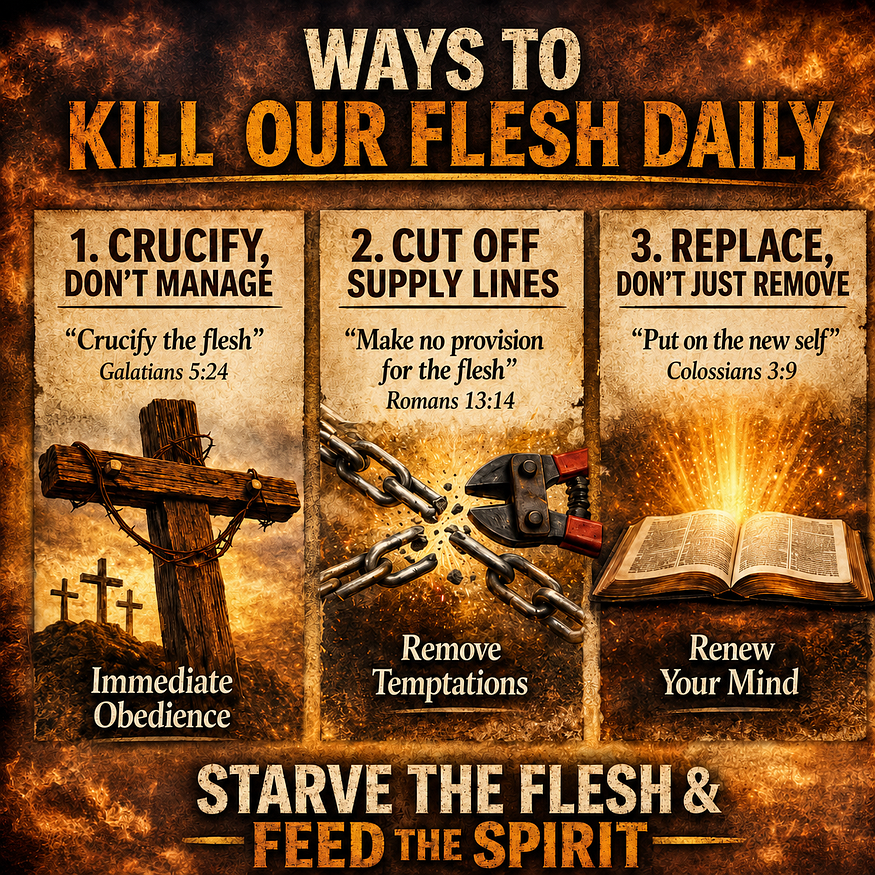
The Christian life is not a life without battle, but it is a life where victory has already been secured in Christ. Every believer who has been born again has been delivered from the dominion of sin, yet still lives in a mortal body where fleshly desires try to rise again. The flesh is not merely the physical body, but the old sinful nature with its passions, lusts, pride, selfishness, anger, jealousy, impurity, greed, bitterness, and rebellion against God. The New Covenant does not teach the believer to improve the flesh, decorate the flesh, educate the flesh, or negotiate with the flesh. The New Covenant teaches that the flesh must be crucified, denied, starved, and replaced by the life of Christ through the Holy Spirit. Paul says, “Now those who belong to Christ Jesus have crucified the flesh with its passions and desires” (Galatians 5:24). This means that every true believer must understand that belonging to Christ is not only receiving forgiveness, but also putting the old life to death. Jesus did not die only to forgive our sins; He died to free us from the slavery of sin when we are still in body. The cross of Christ is not only the place where our guilt was removed, but also the place where our old man was judged. Therefore, daily victory over fleshly desires begins by standing in the truth of what Christ has already done and then applying that truth every day by faith, obedience, and the power of the Holy Spirit.
The question is not merely, “How can I control my flesh?” but “How can I live so that the fleshly desires and influence of this world is no longer allowed to rule me?” Many believers try to manage sinful desires while still feeding them secretly. Many try to overcome temptation while keeping the door open to the very thing that strengthens temptation. Many try to remove sinful habits without putting on Christ, without filling the heart with the Word, without walking in the Spirit, and without renewing the mind. But the New Covenant way is is not managing sin; it is crucifixion. It is not making provision; it is cutting off supply lines. It is not empty removal; it is replacement with the new self. Romans 6:6 says, “our old self was crucified with Him,” so that we would no longer be slaves to sin. Romans 13:14 commands, “put on the Lord Jesus Christ, and make no provision for the flesh in regard to its lusts.” Colossians 3:9–10 says that we have laid aside the old self and have put on the new self. These are not suggestions for advanced Christians only; they are daily commands for every disciple of Jesus Christ. The believer’s victory is not found in confidence in the flesh, but in daily union with Christ, daily dependence on the Spirit, daily obedience to the Word, and daily refusal to provide food for sinful desires.
1. Crucify: Don’t Manage the Flesh
The first New Covenant principle for killing fleshly desires daily is this: crucify the flesh; do not manage it. The flesh is not a weak friend that needs encouragement; it is an enemy that must be put to death. The flesh is not something to be adjusted, trained, tolerated, or entertained; it is something that must be brought under the sentence of the cross. Galatians 5:24 says that those who belong to Christ Jesus have crucified the flesh with its passions and desires. This verse shows that crucifying the flesh is not optional for believers; it is the mark of those who belong to Christ. A person cannot claim to belong to Christ while intentionally protecting the desires that Christ died to destroy. The cross does not make peace with sin; the cross condemns sin. The flesh wants comfort, pleasure, recognition, revenge, control, lust, pride, greed, and self-rule. But the cross says that the old self has no right to rule anymore. Romans 6:6 declares that our old self was crucified with Christ so that we would no longer be slaves to sin. Daily victory begins when we stop negotiating with what God has already condemned.
Crucifying the flesh also means that the believer must accept the daily call of Jesus to deny self and carry the cross. Jesus said in Luke 9:23, “If anyone wishes to come after Me, he must deny himself, and take up his cross daily and follow Me.” This is not a one-time emotional decision, but a daily surrender of self-will to the Lordship of Christ. The flesh says, “Please yourself,” but the cross says, “Deny yourself.” The flesh says, “Protect your pride,” but the cross says, “Humble yourself.” The flesh says, “Take revenge,” but the cross says, “Forgive as Christ forgave you.” The flesh says, “Feed your lust,” but the cross says, “You are not your own; you were bought with a price.” The flesh says, “Live for today’s pleasure,” but the cross says, “Set your mind on the things above.” This daily crucifixion cannot be done by human strength alone, because Romans 8:13 says it is “by the Spirit” that we put to death the deeds of the body. The Holy Spirit does not help us make peace with sin; He empowers us to kill sin. The Spirit brings conviction, gives strength, renews desire, reminds us of Christ, and enables obedience. Therefore, when fleshly desire rises, the believer must immediately bring that desire to the cross and say, “This has no authority over me; I belong to Christ.” The flesh may cry loudly, but it is no longer king. Christ is Lord, and the one who walks by the Spirit will not carry out the desire of the flesh.
The danger in many believers’ lives is that they try to manage the flesh instead of crucifying it. Managing the flesh means keeping sin at a distance but still preserving affection for it in the heart. It means saying, “I will not commit the outward sin,” while still enjoying the inward fantasy. It means saying, “I will not speak angry words,” while still feeding bitterness secretly. It means saying, “I will not fall,” while still keeping the same friendships, same media, same conversations, same private habits, and same thoughts that strengthen temptation. This is not crucifixion; this is religious self-deception, and hypocrisy. Jesus never called us to manage darkness, but to walk in the light. Paul says in Galatians 5:16, “walk by the Spirit, and you will not carry out the desire of the flesh.” The answer to fleshly desire is not a strong willpower, but deeper surrender to the Holy Spirit. The believer must learn to recognize the first movement of the flesh and bring it immediately under Christ. Lust must be crucified before it becomes action. Anger must be crucified before it becomes speech. Pride must be crucified before it becomes self-exaltation. Greed must be crucified before it becomes idolatry. Jealousy must be crucified before it becomes hatred. The daily Christian life is not passive; it is active spiritual warfare under the Lordship of Jesus.
To crucify the flesh daily, the believer must remember his identity in Christ. Romans 6:11 says, “consider yourselves to be dead to sin, but alive to God in Christ Jesus.” This means that the believer must reckon, count, and believe what God says is true. We do not crucify the flesh in order to become accepted by God; we crucify the flesh because we have already been accepted in Christ. We do not fight sin as slaves trying to earn freedom; we fight sin as sons who have already been set free. The New Covenant gives us a new heart, a new Spirit, a new identity, a new Master, and a new direction. Sin may still tempt, but it no longer has rightful dominion. The flesh gains power when the believer forgets the cross, forgets his identity, forgets the Spirit, and forgets eternity. But the flesh loses power when the believer stands in union with Christ. Daily victory begins with daily remembrance: Christ died for me, I died with Him, Christ lives in me, and I now live by faith in the Son of God.
2. Cut Off Supply Lines: Make No Provision for the Flesh
The second New Covenant principle for daily victory is this: cut off the supply lines of the flesh. Romans 13:14 says, “put on the Lord Jesus Christ, and make no provision for the flesh in regard to its lusts.” This verse is very practical and very serious. The flesh cannot grow strong unless it is fed. Sinful desire becomes powerful when the believer keeps giving it fuel. Provision means preparation, supply, opportunity, environment, access, and arrangement. To make provision for the flesh means to create space where sinful desire can easily grow. Many believers pray for victory while still making plans for defeat. They ask God to deliver them from lust but continue to watch, read, search, and follow things that awaken lust. They ask God to deliver them from anger but continue rehearsing offense, listening to gossip, and staying in arguments. They ask God to deliver them from greed but keep filling the heart with comparison, luxury, and discontentment. They ask God to deliver them from pride but continue seeking praise, position, and attention. But Romans 13:14 does not say, “Make a little provision carefully.” It says, “make no provision for the flesh.” The believer who wants victory must stop feeding what he is praying for God to kill.
Jesus taught this same seriousness in Matthew 5:29 when He said that if the right eye causes stumbling, it must be torn out and thrown away. The Lord was not teaching physical self-harm, but spiritual seriousness. He was teaching that anything that becomes a doorway to sin must be removed radically. If a friendship feeds sin, it must be limited or cut off. If a device becomes a doorway to impurity, it must be restricted. If a place awakens old habits, it must be avoided. If a conversation repeatedly leads to anger, gossip, lust, or pride, it must be ended. If social media feeds jealousy, vanity, lust, or comparison, it must be disciplined. If entertainment normalizes what Christ died to cleanse, it must be rejected. The flesh survives through access, repetition, secrecy, and opportunity. Therefore, the believer must not only say no to sin (at the final stage), but also say no to the early pathways that lead to sin. Sin rarely begins with the outward act; it begins with provision. It begins with looking, listening, imagining, planning, hiding, justifying, and lingering. That is why 1 Peter 2:11 says fleshly lusts “wage war against the soul.” These desires are not harmless; they are soldiers fighting against spiritual life. A wise believer does not invite enemies into the house and then wonder why there is no peace.
Cutting off supply lines also requires fleeing, not merely resisting. 2 Timothy 2:22 says, “flee from youthful lusts and pursue righteousness, faith, love and peace.” The Bible does not tell us to stand near sexual lust and prove our strength. It tells us to flee. Joseph did not stay in Potiphar’s house to argue with temptation; he fled. Many believers fall because they overestimate their strength and underestimate the deceitfulness of sin. The flesh says, “You can handle this.” The Spirit says, “Run.” The flesh says, “Just one look.” The Spirit says, “Make no provision.” The flesh says, “You are mature enough.” The Spirit says, “Let him who thinks he stands take heed that he does not fall.” Victory is not proven by how close we stand to temptation, but by how quickly we obey God when temptation appears. A person who plays near fire should not be surprised when he is burned. A person who keeps poison in the house should not be surprised when death spreads. A person who keeps feeding secret sin should not be surprised when desire becomes stronger. Therefore, daily victory requires daily separation from the things that nourish the flesh. This is not legalism; this is wisdom. Grace does not make us careless; grace trains us to deny ungodliness and worldly desires.
The New Covenant believer must understand that cutting off supply lines is not only external but also internal. External doors matter, but the heart must also be guarded. Proverbs 4:23 says, “Watch over your heart with all diligence, for from it flow the springs of life.” The heart is shaped by what it sees, hears, remembers, desires, and meditates upon. If the mind is constantly filled with worldly desires, the flesh will grow strong. If the heart is constantly fed by offense, bitterness will grow. If the imagination is constantly fed by impurity, lust will grow. If the soul is constantly fed by comparison, envy will grow. If the mind is constantly fed by fear, anxiety will grow. Therefore, the believer must guard the heart, guard the eyes, guard the ears, guard the tongue, guard the time, and guard the private life. Secret provision is the root of public failure. What is fed in secret will eventually show itself in conduct. But what is crucified in secret will produce holiness in public. The believer must daily ask, “What am I feeding?” “What am I allowing?” “What am I justifying?” “What am I hiding?” “What is strengthening my flesh?” These questions are not for condemnation, but for cleansing. The Lord exposes provision so that we may remove it and walk in freedom.
Cutting off supply lines also means refusing to cooperate with the patterns of the old life. Ephesians 4:27 says, “do not give the devil an opportunity.” Sinful provision gives the enemy a foothold. Anger gives a foothold. Unforgiveness gives a foothold. Lust gives a foothold. Pride gives a foothold. Greed gives a foothold. Falsehood gives a foothold. The devil cannot own a believer who belongs to Christ, but he can exploit any area we leave unguarded. Therefore, the New Covenant life is a watchful life. Jesus told His disciples to “keep watching and praying” because the spirit is willing but the flesh is weak. Prayer without watchfulness becomes careless. Watchfulness without prayer becomes self-reliant. But prayer with watchfulness is powerful.
3. Replace: Don’t Just Remove — Put On the New Self
The third New Covenant principle for daily victory is this: replace, do not merely remove. Many believers fail because they try to empty the life of sin without filling the life with Christ. But spiritual emptiness is dangerous. Jesus warned that when an unclean spirit goes out and the house is left empty, the later condition can become worse than the first. The New Covenant does not merely say, “Stop lying”; it says, “Speak truth.” It does not merely say, “Stop stealing”; it says, “Work and give.” It does not merely say, “Stop bitterness”; it says, “Forgive as God forgave you.” It does not merely say, “Stop impurity”; it says, “Present your body as holy to the Lord.” It does not merely say, “Stop the old self”; it says, “Put on the new self.” Colossians 3:9–10 says that we have laid aside the old self with its evil practices and have put on the new self. This means the Christian life is not only subtraction, but transformation. Sinful habits must be removed, but holy affections must be cultivated. Fleshly desires must be denied, but spiritual desires must be strengthened. The believer does not become victorious by becoming empty, but by being filled with the life, Word, Spirit, love, and character of Christ.
Ephesians 4:22–24 gives a clear pattern: lay aside the old self, be renewed in the spirit of the mind, and put on the new self. This is the daily pattern of New Covenant sanctification. First, the believer rejects the old self, because it is corrupt according to deceitful desires. Second, the believer is renewed in the mind, because wrong desires are strengthened by wrong thinking. Third, the believer puts on the new self, because holiness must become practical conduct.
Putting on the new self means putting on Christlike character. Colossians 3:12–14 says to put on compassion, kindness, humility, gentleness, patience, forgiveness, and love. These are not natural products of the flesh; they are fruits of the Spirit. The flesh is harsh, but Christ is gentle. The flesh is proud, but Christ is humble. The flesh is selfish, but Christ is loving. The flesh is impatient, but Christ is long-suffering. The flesh is unforgiving, but Christ forgives. The flesh seeks to be served, but Christ came to serve. Therefore, daily victory is not only avoiding bad behavior, but becoming more like Jesus. A man who only avoids lust but does not grow in holiness is still weak. A person who only avoids anger but does not grow in gentleness is still easily provoked. A person who only avoids greed but does not grow in contentment and generosity is still inwardly bound. A person who only avoids pride but does not grow in humility is still self-centered. A person who only avoids gossip but does not grow in love still has an unhealed tongue. The new self must be actively put on.
Galatians 5:16 gives the promise: “walk by the Spirit, and you will not carry out the desire of the flesh.” This verse does not say that the flesh will never desire again. It says that when we walk by the Spirit, we will not carry out its desires. The Spirit-led life is the victorious life. Walking by the Spirit means living under His influence, depending on His power, obeying His conviction, following His direction, and yielding to His fruit. It means the believer does not begin the day in self-confidence, but in surrender. It means we say, “Holy Spirit, lead my thoughts, govern my words, strengthen my obedience, expose my sin, and glorify Christ in me.” The Holy Spirit does not merely restrain the believer from evil; He forms Christ within the believer. He produces love, joy, peace, patience, kindness, goodness, faithfulness, gentleness, and self-control. These fruits are the opposite of fleshly desires. When the heart is filled with Christ, sin loses its attraction.
Conclusion: Daily Death, Daily Victory, Daily Life in Christ
Those who belong to Christ have crucified the flesh with its passions and desires. To be victorious daily, the believer must also cut off supply lines and make no provision for the flesh. The command of Scripture is clear: put on the Lord Jesus Christ and make no provision for the flesh.
This is the New Covenant path of daily victory: crucify, cut off, and replace. Crucify the flesh by standing in the finished work of Christ and putting sin to death by the Spirit. Cut off supply lines by removing every provision, access, and opportunity that feeds sinful desire. Replace the old self by putting on Christ, renewing the mind with the Word, walking by the Spirit, and practicing the character of the new creation. The believer does not fight for victory as though Christ has not won; the believer fights from victory because Christ has conquered sin, death, and the devil. Therefore, every day the believer must say no to the flesh and yes to Christ. Every day the believer must take up the cross and follow Jesus. Every day the believer must make no provision for sin. Every day the believer must put on the new self. And every day, by the Spirit, the believer can walk in victory, holiness, freedom, and the life of Christ.