
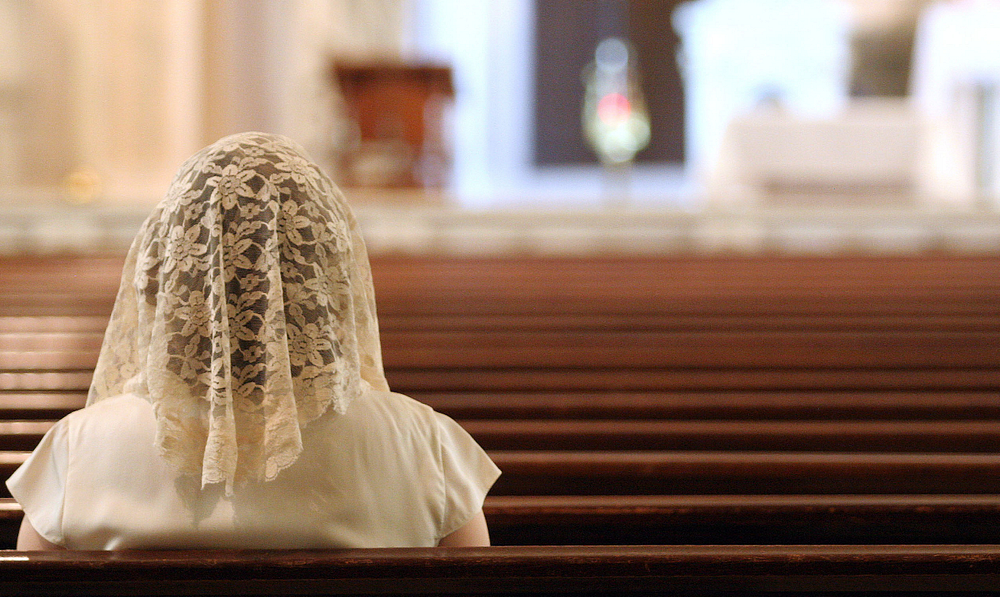
When the Spirit inspired Paul to write 1 Corinthians, He was not merely correcting Corinth’s chaos — He was shaping the church’s worship so that the gathered people of God would reflect heaven’s beauty on earth. That is why Paul does something very pastoral in 1 Corinthians 11:2–16 he takes an outward, visible practice — what men and women do with their heads in prayer and prophecy — and ties it to something inward and eternal: honor, headship, glory, and reverence before God.
Paul’s words are plain:
- “Every man who prays or prophesies with his head covered dishonors his head…”
- “But every woman who prays or prophesies with her head uncovered dishonors her head…”
- “From above, Judge for yourselves: Is it proper for a woman to pray to God with her head uncovered?” (1 Corinthians 11:4–6, 13)
In the New Covenant, we do not obey God to earn acceptance — we obey because we have been accepted in Christ. Yet the grace that saves us also trains us to live reverently (Titus 2:11–12). So when Scripture gives instruction for worship, the humble Christian response is not to argue first, but to listen first — and then to obey with a willing heart.
Worship is not casual — God cares how we approach Him
Under the New Covenant, we have bold access to God through Jesus Christ (Hebrews 10:19–22). But “bold access” does not mean “casual familiarity.” Reverence is not cancelled by grace; reverence is purified by grace.
Paul places head coverings in the context of praying and prophesying — activities of direct spiritual engagement and public witness in worship. That’s important: the issue isn’t fashion; it’s approach. The moment we lift our voices to God — whether in a public assembly or in private devotion — we are doing holy business.
If our worship is truly “in spirit and truth” (John 4:23–24), then our bodies should not contradict our confession. The outer posture should agree with the inner posture: humility, order, and honor.
The principle beneath the practice: headship, honor, and displayed theology
Paul grounds his instruction in a spiritual order: “the head of every man is Christ, the head of a wife is her husband, and the head of Christ is God” (1 Corinthians 11:3). This is not a statement of value (as though one is “more human” than another). It is a statement of order and relationship, just as the Son is not inferior to the Father, yet willingly honors the Father.
So Paul’s concern is this: when the church worships, the church should visibly honor God’s created order rather than blur it. In Paul’s reasoning, a man praying with his head covered communicates the wrong message about the glory order in worship; a woman praying uncovered communicates the wrong message about honoring headship.
This is why Paul uses the language of dishonor — not because a piece of fabric is magical, but because symbols preach. Worship always teaches. The question is: what does our worship teach?
Is a woman’s hair the “covering”? Why “no”
A common objection today is: “Paul says her hair is given to her for a covering, so the hair must be the head covering.” But careful reading shows why many interpreters reject that conclusion.
One detailed argument is that if “covering” simply meant “hair,” several lines in the passage become nonsensical (for example, the contrast between being covered versus shaven), and it would imply men should remove hair entirely to avoid being “covered.”
Additionally, the passage uses different Greek terms for “cover/veil” versus the term used when speaking of hair as a “covering,” suggesting Paul is distinguishing between a removable covering and natural hair.
And the instruction is context-linked: it is applied specifically to “praying and prophesying,” which implies something one can put on and take off with the worship context — something hair does not do.
So, while Paul affirms that long hair is a woman’s glory, many conclude he uses that “natural covering” as an argument for a supplementary head covering in worship, not as a replacement for it.
Public assembly and private devotion: one worship, one reverence
Women should cover their heads when praying or prophesying and men should not, including praise and worship, both in public and private— flows naturally from a simple thought: if God cares about reverence in worship, why would reverence matter only when others are watching?
Jesus warned against practicing righteousness to be seen (Matthew 6:1–6), but He never taught us to stop practicing righteousness. The point is purity of motive. So if a sister covers her head only in public but refuses in private, she may unintentionally reveal that the practice has become a social signal more than a heart posture. And if a brother removes his covering only when others see, the same danger exists.
Private prayer is still prayer. Private worship is still worship. God is still God. The throne room is still holy.
So, for those who practice in public, it makes spiritual sense to apply it consistently: in the congregation and in the home; in prayer and in worship; in singing and in intercession.
What the covering is — and what it is not
If we embrace this practice, we must guard it from two opposite errors:
Error #1: Turning it into salvation.
No one is justified by head coverings. We are justified by faith in Christ alone. A head covering is not a “ticket” into God’s presence — Jesus is.
Error #2: Turning it into rebellion or mockery.
Paul’s language of honor/dishonor makes clear that contempt for God’s order is never neutral. If Scripture convicts, humility says, “Lord, teach me.”
So what is the covering?
- It is a simple, modest, visible sign during prayer and worship that says: I gladly honor God’s order; I do not erase the distinctions He called good; I worship with reverence.
- It is not a stage prop, not a fashion competition, not a reason to exalt oneself over another.
How to practice this without losing the New-Covenant spirit
If you hold this conviction, the New Covenant calls you to practice it with love, meekness, and unity.
- Women: Cover your head as an act of worship. Let it be quiet strength — an offering laid before God. Pair the outward symbol with inward gentleness (1 Peter 3:3–4).
- Men: Uncover your head gladly — honoring Christ as your Head. Let your uncovered head match an uncovered heart before God.
- Church life: Teach it with Scripture. Invite obedience. But do not police with suspicion. And Romans 14 reminds us not to despise one another, but pursue peace and mutual upbuilding (Romans 14:19).
A final appeal: let worship look like worship
In an age that blurs everything — male and female, authority and rebellion, holy and common — God is calling the church to shine with clarity. Not with harshness, but with holiness. Not with pride, but with peace.
When a sister covers her head in prayer, she silently proclaims, “God’s ways are good. I honor His order.” When a brother prays uncovered, he silently proclaims, “Christ is my Head. I worship under His authority.” And when both do it with clean hearts, the church proclaims something our world desperately needs to see again:
Because in the New Covenant, the goal is not merely that we sing loudly, but that we live worshipfully — body, soul, and spirit — under the Lordship of Jesus Christ.
Reference
https://trinitybiblechapel.ca/is-a-womans-hair-the-headcovering-of-1-cor-11/