
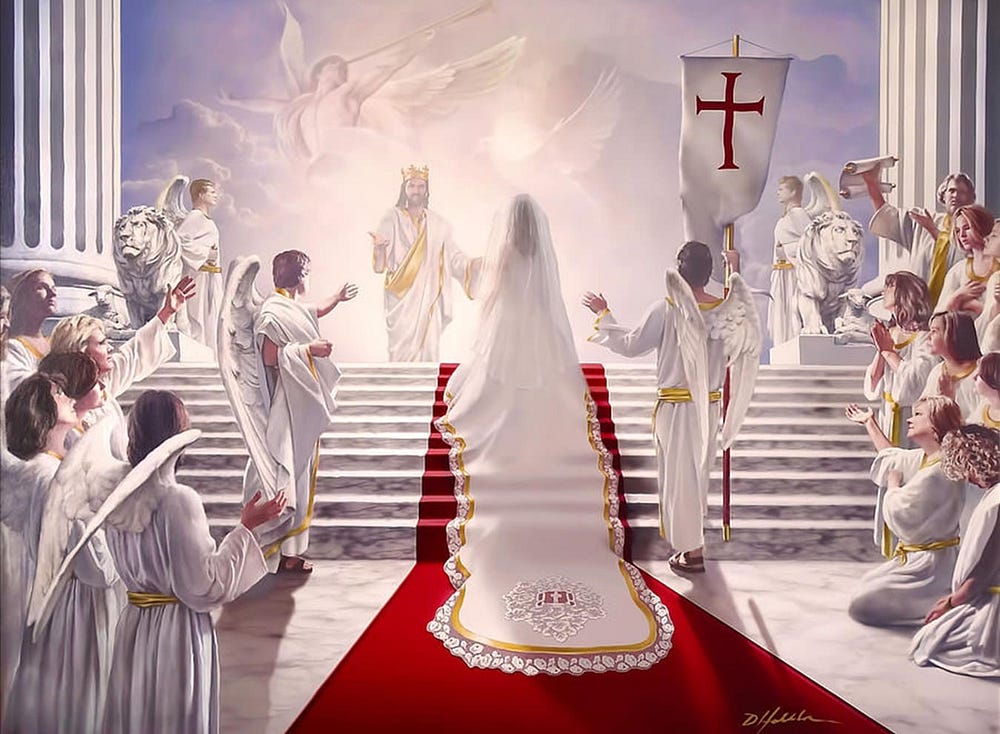
Scripture repeatedly uses the language of marriage to describe the covenant relationship between God and His people. In the Old Testament, the Lord spoke of Israel as His wife, and in the New Testament, Christ is revealed as the Bridegroom and the church as His bride. This is not a casual comparison, but a holy and covenantal picture that helps us understand love, faithfulness, submission, trust, provision, intimacy, and obedience. Ephesians 5:31–32 says, “For this reason a man shall leave his father and mother and be joined to his wife, and the two shall become one flesh. This mystery is great; but I am speaking with reference to Christ and the church.” John the Baptist said in John 3:29, “He who has the bride is the bridegroom.” Revelation 19:7 declares, “Let us rejoice and be glad and give the glory to Him, for the marriage of the Lamb has come and His bride has made herself ready.” These verses show that marriage is not merely a social institution, but also a divine signpost pointing to spiritual reality.
In marriage imagery, the church is called the bride not to humiliate believers, but to teach dependence, devotion, and covenant love. In our walk with God, we often behave like an anxious spouse who struggles to trust the one who truly loves, protects, and provides. We ask, we question, we fear, we complain, and then still run back to Him for mercy, and help. The glory of the gospel is that Christ remains faithful even when His people are unstable. He does not abandon His bride, but sanctifies her, teaches her, and prepares her for eternal union with Himself. The relationship of believers with God is therefore beautifully seen in the relationship of a wife with her husband, especially when that marriage reflects God’s order, love, holiness, and covenant faithfulness.
Christ the Husband, the Church the Bride
The Bible clearly teaches that the relationship between Christ and believers is that of Bridegroom and bride. Isaiah 54:5 says, “For your husband is your Maker, whose name is the Lord of hosts.” Hosea 2:19 says, “I will betroth you to Me forever; yes, I will betroth you to Me in righteousness and in justice, in lovingkindness and in compassion.” In the New Testament, 2 Corinthians 11:2 says, “For I am jealous for you with a godly jealousy; for I betrothed you to one husband, so that to Christ I might present you as a pure virgin.” These verses reveal that God does not relate to His people as a distant ruler only, but as a covenant Husband who binds Himself to them in love. The church is not merely an organization, and salvation is not merely a legal transaction. The believer is brought into covenant union with Christ. This union includes love, loyalty, belonging, intimacy, and mutual knowledge. Just as a wife bears the name, home, and honor of her husband, believers now belong to Christ and bear His name in the world. Our identity is no longer centered in ourselves, but in the One to whom we are joined. We are His, and He is ours. That is the language of covenant love.
This means the Christian life is not meant to be lived as an independent existence. A faithful wife does not live as though she belongs to herself alone, and likewise believers are not called to self-rule. First Corinthians 6:19–20 says, “You are not your own… For you have been bought with a price.” The soul that truly understands redemption realizes that Christ has rights over our thoughts, desires, decisions, affections, and priorities. We do not simply receive blessings from Him; we belong to Him. The problem with many believers is that they want the protection of the covenant without the obedience of the covenant. They want Christ as Savior, Provider, Healer, and Defender, but do not want Him as Lord, Head, and Husband. But the marriage picture does not permit selective devotion. A bride cannot say, “I want his house, his name, and his care, but not his leadership.” In the same way, believers cannot genuinely walk with God while resisting His authority. True covenant love receives both the tenderness and the rule of Christ. When the church understands herself as the bride, she stops negotiating with God as though He were merely a servant of her wishes. She begins to yield, to trust, and to delight in belonging fully to Him.
The Bride’s Need for Trust Over Fear and Doubt
One of the deepest struggles in the believer’s relationship with God is the battle between trust and insecurity. Even though God has proven His faithfulness repeatedly, believers often become anxious, suspicious, and unsettled when circumstances become difficult. Psalm 56:3 says, “When I am afraid, I will put my trust in You.” Proverbs 3:5 says, “Trust in the Lord with all your heart and do not lean on your own understanding.” James 1:6 warns, “But he must ask in faith without any doubting, for the one who doubts is like the surf of the sea, driven and tossed by the wind.” Many believers live as though they are uncertain whether God truly knows what He is doing. They question His timing, His decisions, His silence, and His methods. They pray for one thing, and when He answers differently, they feel hurt or offended. They see delay as neglect, discipline as rejection, and mystery as absence. But the Lord is not unfaithful because He does not obey our emotions. He is faithful precisely because He remains wise, steady, and holy even when we are unstable. Trust is one of the clearest signs that the bride honors the Bridegroom.
Israel often failed in this very area. In Exodus 16:8 Moses said, “For the Lord hears your grumblings which you grumble against Him.” Again and again, the people complained though they had already seen miracles, deliverance, and provision. Their problem was not lack of evidence, but lack of trust. Believers often do the same. We say God is sovereign, yet panic when money is low. We say He is loving, yet accuse Him when prayers seem unanswered. We say He is our Shepherd, yet resist the paths He chooses. A faithful bride learns that the wisdom of her husband is not invalidated by her inability to understand his decisions in the moment. Likewise the church must mature beyond emotional reactions into steady faith. Faith does not mean the believer has no questions, but it means questions are brought into the presence of God with humility rather than accusation. The bride may pour out her heart, but she does not have to revolt in order to be heard. She can speak honestly and still remain surrendered. The spiritual beauty of the church is seen when believers move from restless suspicion to peaceful confidence in the character of Christ. The more we know Him, the less reason we have to doubt Him.
Christ as Provider, Protector, and Sustainer of His Bride
A husband in biblical order is called to care for, protect, and provide for his household, and this reflects the way Christ ministers to His people. Philippians 4:19 says, “And my God will supply all your needs according to His riches in glory in Christ Jesus.” Psalm 23:1 declares, “The Lord is my shepherd, I shall not want.” Matthew 6:31–33 says, “Do not worry then, saying, ‘What will we eat?’ or ‘What will we drink?’ or ‘What will we wear for clothing?’… But seek first His kingdom and His righteousness, and all these things will be added to you.” Ephesians 5:29 says concerning the marital picture, “For no one ever hated his own flesh, but nourishes and cherishes it, just as Christ also does the church.” Christ is not careless with His bride. He nourishes, cherishes, sustains, and watches over her. Believers can come to God with needs, burdens, and fears because deep within them they know that all true provision is from Him. This instinct is not wrong. It is right for the bride to look to the Bridegroom. It is right for the church to depend on Christ. It is right for the believer to seek divine care in moments of need.
However, trouble begins when provision becomes the center of the relationship rather than the fruit of the relationship. Some believers approach God only when they need something material, emotional, financial, or physical. They treat prayer as a demand center rather than communion with the Lord. But a healthy covenant relationship is not built merely on gifts, but on love and trust. The believer must learn to value the presence of God above the provision of God. A faithful wife does not remain in covenant merely because her husband pays the bills; she remains because of love, honor, commitment, and shared life. So also the church must seek Christ not only for bread, but for Himself. In John 6:26 Jesus rebuked those who followed Him merely because they ate the loaves and were filled. God does provide, and He delights to care for His people, but He will not allow His bride to reduce Him to a dispenser of benefits. He trains us to seek first His kingdom, knowing that when our priorities are rightly ordered, provision will find its proper place. The bride who trusts the Husband’s heart does not live in constant panic over tomorrow. She rests in the faithfulness of the One who knows her needs before she asks.
Submission to the Will of the Husband as Believers Submit to God
The marriage metaphor teaches not only love and provision, but also order. Ephesians 5:22–24 says, “Wives, be subject to your own husbands, as to the Lord. For the husband is the head of the wife, as Christ also is the head of the church… as the church is subject to Christ, so also the wives ought to be to their husbands in everything.” Colossians 3:18 says, “Wives, be subject to your husbands, as is fitting in the Lord.” At the same time, Jesus Himself modeled the spirit of submission before the Father in Luke 22:42, “Not My will, but Yours be done.” Submission in the biblical sense is not inferiority, silence, or worthlessness. It is the willing alignment of one’s heart under God’s appointed order. In the believer’s relationship with God, submission means that we do not insist on self-rule. It means we surrender our opinions, preferences, plans, and desires to the wisdom of God. It means we stop trying to make God agree with us and instead allow Him to transform us until we agree with Him. The bride may speak, ask, express, and pray, but her final posture is yieldedness. She does not fight for autonomous control while claiming covenant intimacy.
This is one of the hardest lessons in the Christian life. Many believers love God’s promises but resist His commands. They want His comfort but not His correction. They want His blessings but not His governance. Yet the beauty of submission is that it brings the believer into the peace of divine order. Romans 12:2 says, “Do not be conformed to this world, but be transformed by the renewing of your mind, so that you may prove what the will of God is.” The renewed mind does not merely endure God’s will; it learns to love it. In a godly marriage, a wife may share her thoughts, concerns, and burdens with her husband, and this is part of intimacy. Likewise believers are invited to pour out their hearts before God. Psalm 62:8 says, “Trust in Him at all times, O people; pour out your heart before Him.” Yet after speaking, the bride must still rest in the headship of the Bridegroom. Even when God’s answer differs from our request, faith says yes to Him. Submission is not passive resignation; it is active agreement with divine wisdom. It is the glad participation of the soul in the purposes of God.
The Bride Is Sanctified, Corrected, and Made Ready
The Lord does not merely love His bride; He also sanctifies her. Ephesians 5:25–27 says, “Christ also loved the church and gave Himself up for her, so that He might sanctify her… that He might present to Himself the church in all her glory, having no spot or wrinkle.” Hebrews 12:6 says, “For those whom the Lord loves He disciplines.” John 15:2 says, “Every branch that bears fruit, He prunes it so that it may bear more fruit.” This means that Christ’s love is not indulgent. He does not merely comfort the church in her present condition; He labors to transform her. Many believers misunderstand divine correction. When God confronts sin, delays an answer, removes something harmful, or disciplines disobedience, they think He has become harsh or unloving. His correction is proof of covenant love. A careless husband might ignore the destruction of his house, but a faithful husband labors to preserve holiness, order, and peace in the home. So Christ watches over His bride with jealous love. He will not leave her to immaturity, rebellion, carnality, and spiritual instability. He washes, prunes, teaches, and disciplines her because He intends to present her glorious.
Some prayers are unanswered because the request is immature. Some doors are closed because the path is dangerous. Some seasons are hard because the Lord is purifying the heart. The bride of Christ is not only loved; she is prepared. Revelation 19:7 says, “His bride has made herself ready.” Preparation involves sanctification. It involves letting go of murmuring, unbelief, fleshly demands, bitterness, self-will, and double-mindedness. It involves becoming the kind of people who reflect the nature of the Bridegroom. Christ wants a bride who trusts Him, loves righteousness, hates evil, and delights in His will. He is not preparing us for earthly comfort, but for eternal union. The church that embraces sanctification stops complaining about the tools God uses to purify her. She begins to say, “Lord, do whatever is necessary to make me holy.” This is the language of a bride who values purity more than convenience. It is the response of believers who understand that discipline is not the destruction of love, but one of its highest forms.
Prayer, Communion, and Shared Heart in the Covenant
In a healthy marriage, there is communication, openness, and the sharing of burdens, desires, and concerns. Likewise, believers are invited into living communion with God. Philippians 4:6 says, “Be anxious for nothing, but in everything by prayer and supplication with thanksgiving let your requests be made known to God.” First Peter 5:7 says, “Casting all your anxiety on Him, because He cares for you.” Hebrews 4:16 says, “Therefore let us draw near with confidence to the throne of grace.” These verses show that the bride is not shut out from the heart of the Bridegroom. She is welcomed to speak. She is invited to draw near. She is permitted to express fear, grief, desire, confusion, and need. Prayer is not rebellion; it is relationship. The believer does not dishonor God by bringing burdens before Him. In fact, refusing to bring them may reveal pride, independence, or unbelief. The bride shares her heart because she trusts the covenant bond. She knows she is heard. She knows she is loved. She knows her Husband is not indifferent to her tears.
Yet prayer must remain prayer, not control. There is a difference between sharing one’s heart and demanding one’s way. Jesus taught this spirit in Matthew 6:10, “Your kingdom come. Your will be done.” The mature believer prays boldly, honestly, and persistently, but also submissively. The goal of prayer is not to make God serve our private kingdom, but to draw our hearts into His. In this way, prayer becomes one of the most beautiful expressions of the bride’s relationship with Christ. She speaks freely, but not arrogantly. She asks earnestly, but not rebelliously. She weeps honestly, but not hopelessly. She waits expectantly, but not accusingly. And when the answer comes in a form she did not expect, she still trusts the wisdom of the One who answers. This is the posture of covenant communion. The deeper believers grow in prayer, the more they learn that the greatest answer is often not the granting of a request, but the increasing knowledge of God Himself.
Conclusion
The relationship believers have with God is indeed beautifully pictured in the relationship of a wife with her husband. Christ is the loving Husband, and the church is His redeemed bride. He provides, protects, cherishes, leads, sanctifies, and remains faithful. Believers, like a bride, are called to trust, submit, commune, obey, and rest in covenant love. We often come with fears, complaints, emotional instability, and material needs, yet the Lord does not cast us away. Instead, He teaches us to move from anxiety to trust, from self-will to surrender, from murmuring to worship, and from spiritual immaturity to bridal readiness. Every believer, whether man or woman, stands before Christ as part of His bride, called into covenant intimacy, obedience, and love. The healthiest spiritual life is found when the church stops resisting the Bridegroom and begins delighting in His will. Blessed are those believers who not only seek His hand, but love His heart; not only receive His gifts, but yield to His lordship; not only call Him Savior, but honor Him as Husband and King.