
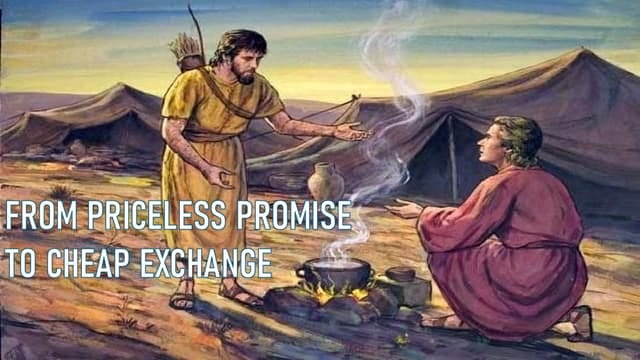
Esau’s story is one of the most tragic “moments” in Scripture, which changes the course of God’s lineage and election from one person to another. Genesis tells us that Esau came in from the field exhausted and hungry, and Jacob had stew. In that moment Esau said, “I am about to die; of what use is a birthright to me?” (Genesis 25:32). And for one meal, he sold what could not be replaced.
Esau thought he was making a practical choice. He treated the birthright like a useless piece of paper compared with something warm and immediate. But Heaven recorded it differently. Hebrews 12:16 warns the church: “See to it that no one is… godless like Esau, who for a single meal sold his inheritance rights.” Scripture calls it godless — not because he ate stew, but because he treated holy things as common, spiritual inheritance as negotiable, and future glory as irrelevant when compared with present craving.
That is the danger for believers today under the New Covenant: even after we know the truth, manytimes we live like the truth is not valuable. We confess Christ with our mouths, yet in moments of pressure, desire, loneliness, fatigue, or temptation, we often trade our spiritual inheritance for instant pleasure, physical comfort, and temporary relief.
What Esau Really Sold
The birthright was not merely a family tradition. In Abraham’s line, it carried covenant weight. It included leadership in the family, a double portion of inheritance, and a spiritual privilege tied to God’s promises (Genesis 25:23; 27:27–29). In God’s unfolding plan, that covenant line would eventually produce the nation of Israel — and from Israel, the Messiah would come according to the flesh (Matthew 1:1–16; Romans 9:4–5).
Esau wasn’t thinking about any of that. He was thinking about his stomach.
And that is exactly how the flesh speaks. The flesh always says:
- “Now matters more than later.”
- “Relief matters more than righteousness.”
- “Feeling full matters more than being faithful.”
- “Just this once — because I need it.”
Esau’s words, “I am about to die,” show exaggeration driven by appetite. Hunger felt like death. Craving felt like emergency. But what feels urgent is not always important. Many spiritual defeats happen because a believer treats temptation like a life-or-death crisis, instead of recognizing it as a test of worship.
Three Attributes That Trapped Esau — and Trap Us
The three characteristics, that trapped Esau — and are often seen as temptations deceive believers today.
Instant pleasure: Esau chose what would satisfy him immediately over what would bless him eternally.
Physical needs: His body’s voice became louder than God’s promise.
Present comfort: He refused to endure discomfort for long-term reward.
This is not only an “Esau problem.” This is a human problem. Even today, people can trade prayer for visibility, purity for a moment, obedience for convenience, fellowship for isolation, and holiness for comfort. The stew changes, but the exchange is the same: we swap eternal inheritance for temporary satisfaction.
Scripture describes this as being “profane” or “godless” (Hebrews 12:16). Profane doesn’t mean “evil-looking.” It means treating sacred things as ordinary. It means living with no reverence for what God calls holy.
The New Covenant Inheritance: What We’re Being Warned Not to Despise
Under the New Covenant, our inheritance is not land, livestock, or family rank. Our inheritance is Christ Himself, and everything God has given us in Him.
Colossians 1:12 says the Father “has qualified you to share in the inheritance of the saints in the kingdom of light.” That means your inheritance is real, present, and secured by God — not by your merit.
In Christ, you have:
- Adoption and sonship (Romans 8:15–17; Galatians 4:4–7)
- Redemption and forgiveness (Ephesians 1:7)
- Access to God (Hebrews 10:19–22)
- The indwelling Holy Spirit as a seal and guarantee (Ephesians 1:13–14)
- A living hope and an imperishable inheritance (1 Peter 1:3–4)
- Authority to resist sin and walk in newness of life (Romans 6:11–14)
So when a believer trades obedience for sin, they are not only “breaking a rule.” They are despising a gift. They are acting as though Christ is not enough, the Spirit is not strong enough, and the Father’s promise is not valuable enough to endure discomfort.
Esau Lost More Than a Meal Can Measure
Later, Esau wept because he wanted the blessing back, but he could not reverse what his choice had set in motion (Hebrews 12:17; Genesis 27:34). His tears were real, genuine tears can bring repentance from sin, but cannot undo the sin. Many people sorrow over consequences. Esau’s grief shows something sobering: a single “small” trade can carry a permanent shadow, because it reveals what a person truly values when pressure is high.
This is where Scripture’s principle becomes painfully clear: whatever we sow, we shall reap (Galatians 6:7–8). Life under God is not random. Choices are seeds. Actions are seeds. Habits are seeds. Words are seeds. And seeds don’t only produce a moment — they produce a harvest. You cannot reap strawberries if you have sowed blueberries. In the same way, you cannot sow compromise and expect to reap spiritual authority. You cannot sow secret sin and expect to reap intimacy with God. You cannot sow laziness in prayer and expect to reap sharp discernment. You cannot sow bitterness and expect to reap peace.
We have a choice in what we sow, but once we sow, we don’t get to choose the harvest. That’s exactly why Scripture warns us. We can choose what we plant today. But after the seed is in the ground, it grows according to its kind. The harvest comes in its season, and it comes with its own.
Esau sowed contempt for what was sacred. He treated the birthright like a disposable thing, and he reaped a loss he could not simply undo. He lost a spiritual position and a legacy that could not be repurchased with regret. Don’t trade away obedience for relief and then be shocked when the harvest tastes like emptiness.
The mercy of God is real, and the blood of Jesus cleanses and restores. But the principle remains: sowing and reaping is still a law of spiritual life. So the Spirit invites us to be sober: sow to the Spirit, and you will reap life (Galatians 6:8). Choose the seed carefully — because the harvest will follow the seed.
Jesus: The True Firstborn Who Never Sold His Inheritance
Where Esau failed, Jesus triumphed. Jesus faced hunger in the wilderness. After forty days, He was hungry, and the tempter offered Him “stew” — instant satisfaction: “If You are the Son of God, command these stones to become bread” (Matthew 4:3). But Jesus refused to trade sonship obedience for appetite relief. He answered, “Man shall not live by bread alone, but by every word that comes from the mouth of God” (Matthew 4:4).
Esau said, “What good is the birthright?”
Jesus lived, “What good is bread if it costs obedience?”
And then Jesus did something even more glorious: He did not merely keep the inheritance — He shared it. He is the “firstborn among many brothers” (Romans 8:29). He brings many sons to glory (Hebrews 2:10). He qualifies the unqualified (Colossians 1:12). He redeems those who wasted years trading with sin — and He restores them to sonship.
So the call of this message is not, “Try harder so God will accept you.”
rather, “Look at what you already have in Christ — start living in Him.”
How Believers Trade Like Esau Today
Let’s be honest and specific. Stew often looks like:
- Secret sin that promises comfort but produces bondage (John 8:34)
- Bitterness that feels justified but poisons worship (Hebrews 12:15)
- Compromise that protects reputation but weakens conscience
- Worldly priorities — money, pleasure, applause — while neglecting eternal things (1 John 2:15–17)
- Neglect of prayer and Word because the flesh wants easier food
The flesh always makes spiritual things seem distant and less “real.” But the Spirit makes eternal things weighty, beautiful, and worth suffering for.
Practical Ways to Stop Trading Your Inheritance
The New Covenant gives you more than a warning — it gives you a pathway.
(1) Put a name on the stew.
What is your usual trade? Comfort? Lust? Pride? Anger? Boasting? Approval? Control? Arrogance? Escapism? Identify it, because unnamed enemies keep winning.
(2) Remember your value in Christ daily.
You don’t resist sin by willpower alone. You resist by revelation — seeing the worth of what you have: “the inheritance of the saints in light” (Colossians 1:12).
(3) Feed your spirit before the hunger hits.
Esau came in starving. Many believers fall because they live spiritually malnourished. Abide in Christ (John 15:4–5). Store the Word in your heart (Psalm 119:11). Pray before pressure comes.
(4) Endure discomfort as worship.
Sometimes obedience feels like loss — like hunger. But suffering for righteousness produces life (1 Peter 3:14). The cross always feels costly to the flesh, but it opens resurrection life in the spirit (Luke 9:23).
(5) Run to Christ quickly when you fail.
The devil says, “You traded again — now hide.”
The Spirit says, “Return — confess — be cleansed — stand up again” (1 John 1:9; Proverbs 24:16). The New Covenant is not permission to sin; it is power to rise.
A Call to Reverence and Renewal
Hebrews 12 is not merely warning against Esau; it is calling the church to pursue holiness, to strengthen weaknees, to make straight paths, and to live with reverence (Hebrews 12:12–14, 28). God is not trying to take your joy — He is trying to protect your inheritance.
Beloved, you are not called to be led by appetite. You are called to be led by the Spirit (Galatians 5:16). You are not called to trade eternal treasure for temporary pleasure. You are called to live as an heir.
So when the moment comes — when the stew is steaming and the craving feels urgent — pause and remember:
- You are qualified by the Father (Colossians 1:12).
- You are sealed by the Spirit (Ephesians 1:13–14).
- You are purchased by the blood (1 Peter 1:18–19).
- You are an heir with Christ (Romans 8:17).
Don’t sell what Christ died to give you. Don’t call cheap what Heaven calls precious. Don’t trade your inheritance for a bowl that will be empty again tomorrow.
Closing Prayer
Father, open our eyes to the value of what You have given us in Christ. Forgive us for the times we have traded holiness for comfort and for pleasure. Strengthen us by Your Spirit to endure temptation and to choose what pleases You. Teach us to live as sons and daughters, revering Your promises and treasuring our inheritance in the kingdom of light. In Jesus’ name, amen.