
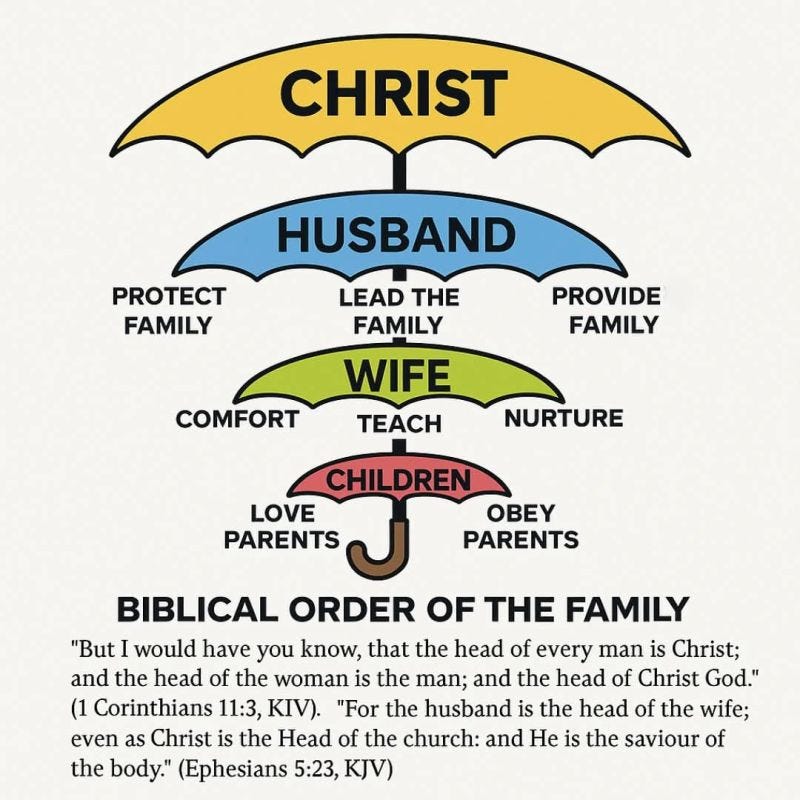
One of the clearest — and most misunderstood — biblical patterns is the order of headship that God established and then reaffirmed in the New Covenant.
- The head of Christ is God (the Father).
- The head of man (husband) is Christ.
- The head of woman (wife) is man (husband).
This framework is stated plainly in 1 Corinthians 11:3: “But I want you to know that the head of every man is Christ, the head of woman is man, and the head of Christ is God.” Headship is not a worldly hierarchy of “greater value vs lesser value.” The Bible never teaches that. Rather, it is an order of responsibility, covering, accountability, and loving leadership — and it is meant to display the glory of God, the beauty of Christ’s lordship, and the harmony of the home and the church.
But we must define this carefully: headship is about lordship and submission, yes — but not in the way the world defines those words. In the kingdom of God, “lordship” is expressed through sacrifice, service, and holiness. And “submission” is expressed through trust, honor, order, and willing cooperation for God’s purposes. In the New Covenant, headship is meant to look like Christ and His church, not like fallen human power.
The Head of Christ Is God: A Pattern of Willing Submission
Paul says something astonishing: “the head of Christ is God.” Christ is not inferior to the Father in nature. Jesus is fully divine. Yet in His mission as the incarnate Son, Jesus willingly submitted to the Father’s will to accomplish redemption.
Jesus said, “I have come down from heaven, not to do My own will, but the will of Him who sent Me” (John 6:38). He also prayed in Gethsemane, “Not My will, but Yours, be done” (Luke 22:42). This is not weakness — this is holiness. This is not oppression — this is love and obedience.
So the very first thing we learn about headship is this:
Submission can be perfectly holy, perfectly voluntary, and perfectly powerful.
Christ’s submission was not because He lacked worth. It was because He was fulfilling the Father’s plan with complete trust and unity.
And notice: the Father’s “headship” over Christ did not mean harsh domination. The Father glorified the Son and loved Him deeply. Jesus said, “The Father loves the Son” (John 3:35). Headship, at its purest, is loving authority that protects mission, preserves order, and expresses unity.
If the relationship between Father and Son is marked by love, honor, and unity, then every form of headship under God must reflect the same spirit.
The Head of the Husband Is Christ: A Man Under Authority
This means a husband is never an “independent ruler.” He is a man under lordship. Christ is not merely a helper to the husband — Christ is the husband’s Head. That means:
- Christ commands him.
- Christ corrects him.
- Christ shapes his character.
- Christ judges his leadership.
In the New Covenant, no man can lead rightly unless he is first led by Jesus.
This is why biblical headship begins with obedience to Christ. A husband cannot claim authority while living in rebellion. He cannot demand respect while refusing repentance. He cannot call for submission while rejecting the lordship of Christ over his own life.
Jesus warned against worldly leadership styles: “You know that the rulers of the Gentiles lord it over them… Yet it shall not be so among you; but whoever desires to become great among you, let him be your servant” (Matthew 20:25–26). Christlike headship does not “lord over.” It serves, protects, guides, and sacrifices.
This is why Paul commands husbands: “Husbands, love your wives, just as Christ also loved the church and gave Himself for her” (Ephesians 5:25). That one verse destroys every abusive idea of headship. Christ’s headship was proven not by control, but by the cross.
So a husband’s headship is not a license to demand; it is a calling to die to self.
The Head of the Wife Is the Husband: Submission as a Spiritual Grace
Then Scripture says: the head of the wife is the husband (1 Corinthians 11:3). In the New Covenant, this is not presented as a curse; it is presented as a created order and a spiritual picture.
Paul connects marital order to Christ and the church: “For the husband is head of the wife, as also Christ is head of the church” (Ephesians 5:23). This comparison matters: a wife is not called to submit because her husband is perfect; she is called to honor God’s order as an act of faith, just as the church submits to Christ. And yet, this also means the husband’s headship must look like Christ — pure, faithful, sacrificial, and holy.
The New Covenant call to wives is: “Wives, submit to your own husbands, as to the Lord” (Ephesians 5:22). That phrase — “as to the Lord” — makes the submission spiritual, not merely relational. A wife’s submission is first worship toward God, not mere compliance toward man.
But it must be said clearly: the Bible never calls a wife to participate in sin, deception, or disobedience to Christ. Submission is never submission to evil. The highest authority over both husband and wife is Jesus.
Peter writes: “Wives, likewise, be submissive to your own husbands… when they observe your chaste conduct accompanied by fear” (1 Peter 3:1–2). Notice again: it is a submission that flows from reverence for God, purity of life, and spiritual strength. This is not servitude. This is faith-filled cooperation with God’s design.
Headship Is Lordship and Submission — but Kingdom-Style
You said: “Headship is about lordship and submission.” Yes — but the New Covenant transforms how those words look.
Kingdom lordship looks like:
- responsibility, not privilege
- sacrifice, not selfishness
- servant leadership, not domination
- protection, not intimidation
- guidance, not harshness
- prayer, not pressure
- humility, not ego
Christ is Lord, yet He washed feet (John 13:14–15). Christ is Head, yet He laid down His life (Ephesians 5:25). That is the template.
Kingdom submission looks like:
- honor, not fear
- cooperation, not erasing personhood
- trust, not blind silence
- peaceable order, not disorder
- strength under God, not weakness under man
Submission is not the loss of value. Jesus submitted to the Father. The church submits to Christ. Submission is not about “lesser worth”; it is about covenant order that reflects heaven.
The Purpose of Headship: Displaying Christ
Why does God care about this order? Because marriage is not just about two people living together. Marriage is a living parable: Christ and His bride.
When a husband leads with Christlike love, and a wife responds with godly honor, their home becomes a visible sermon of the gospel. That is why Paul says this mystery is profound and points to Christ and the church (Ephesians 5:32).
Headship, done rightly, produces:
- peace instead of rivalry
- clarity instead of confusion
- unity instead of competition
- protection instead of exposure
- fruitfulness instead of frustration
This is not a worldly power structure. It is a spiritual order meant to cultivate love, holiness, stability, and mission.
Practical New Covenant Applications
For husbands:
- Submit to Christ daily. You cannot lead if you won’t bow.
- Lead with prayer and the Word. Headship without Scripture becomes fleshly control.
- Love sacrificially. Ask: “What would bless her soul?” not “What proves my authority?”
- Protect and provide spiritually. Cover her with intercession, purity, and faithfulness.
- Repent quickly. A humble head is safer than a proud head.
For wives:
- Submit to Husband “as to the Lord.” Make it worship, not resentment.
- Honor, encourage, and build. Respect strengthens godly leadership.
- Use wisdom with humility. Submission is not silence; it is influence without usurpation.
- Keep Christ as your highest allegiance. Your conscience belongs to God.
- Trust God’s order even when you don’t feel it. Faith often precedes feelings.
For both:
Mutual love and mutual service must fill the home. Ephesians 5 calls wives to submit and husbands to die to self — both are impossible without the Spirit. The New Covenant doesn’t produce this by mere rule-keeping, but by the life of Christ within.
Conclusion: A Chain of Glory, Not a Chain of Bondage
The order is clear: God → Christ → husband → wife. But this is not a chain of bondage. It is a chain of glory when lived out in the Spirit.
Christ shows us what submission looks like without inferiority. The Father shows us what headship looks like without tyranny. And the marriage relationship becomes a holy stage where the gospel is acted out daily.
So let every husband ask: “Am I under Christ, and does my leadership look like the cross?”
Let every wife ask: “Am I honoring God’s order with faith, purity, and strength?”
And let both ask: “Does our marriage make Christ more visible?”
Because headship is not ultimately about control. It is about Christ’s lordship displayed through love, and godly submission offered as worship.