
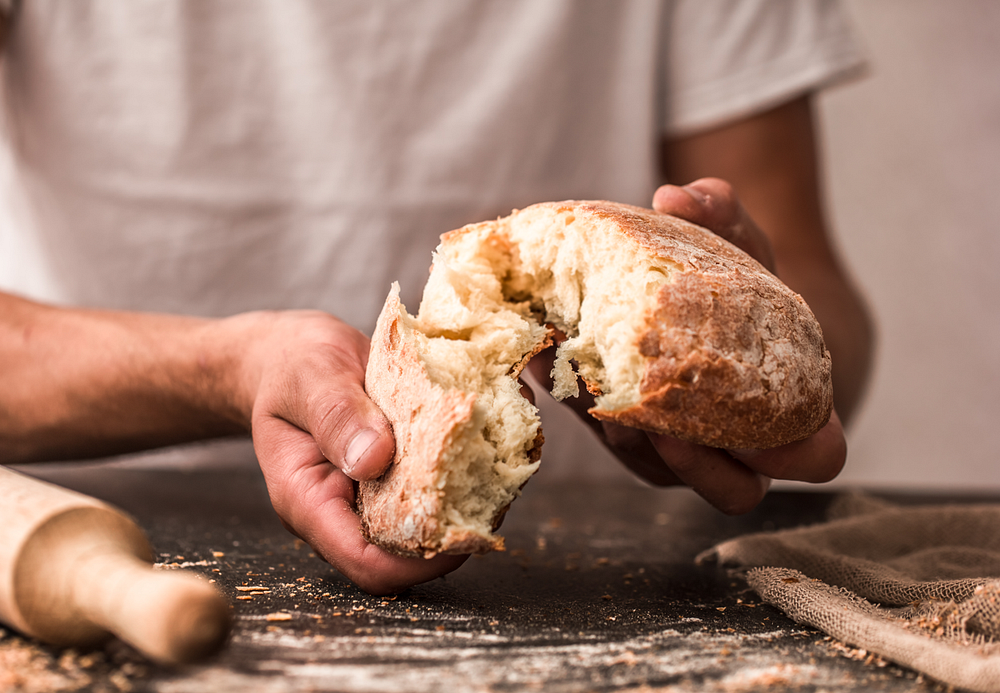
Jesus did not feed the five thousand by giving them a lesson in budgeting. He fed them by taking what was small, placing it in the Father’s hands, and allowing it to be broken. The miracle of multiplication began with a moment of surrender: “Jesus took bread, and when he had given thanks, he broke it and gave it to his disciples…” (Matthew 26:26). In the hands of Christ, what is offered becomes enough — and what is broken becomes a blessing.
This is one of the great mysteries of the New Covenant life: God often multiplies through what He first breaks. Not because He enjoys crushing people, but because He is freeing them — breaking pride, self-reliance, and the stubborn shell of the flesh — so the life of the Spirit can flow without hindrance. Many believers want the “multiplication” of impact, the “fruit” of holiness, the “power” of usefulness, but resist the very processes God uses: breaking and pruning.
The Bread Must Be Broken Before It Can Be Shared
The bread did not multiply while it stayed safely in a basket. It multiplied as it was distributed — as it was broken and given away. In the same way, many Christians remain “whole” in the eyes of the world: protected image, protected ego, protected comfort, protected ambitions. Yet they feel spiritually barren. Often, the reason is not that God has abandoned them; it is that they have not yielded to God’s hands.
Under the New Covenant, God does not merely improve behavior; He forms Christ within us. God’s hands shape us through surrender, obedience, trials, correction, and the gentle but firm breaking of self. The Lord is not trying to destroy your personality; He is trying to destroy your independence from Him.
When Jesus “broke” the bread, the bread did not complain. Bread does not argue. Bread does not negotiate. Bread does not demand control. Bread simply yields to the hands of the one who holds it. A mature Christian learns the same posture: “Lord, I am Yours. Do what You must do so that You may do what You want through me.”
This is why true humility is not merely a personality trait — it is spiritual alignment. God gives grace to the humble because humility is the posture that can carry His life. Pride fights for control; humility yields to Christ. And where Christ is welcomed, His Spirit works freely.
“Broken” Does Not Mean “Rejected”
Some believers fear breaking because they associate it with rejection or abandonment. But in the gospel, breaking is often the opposite. Jesus broke the bread because He intended to feed people with it. God breaks what He plans to use. He disciplines those He loves, not as condemnation, but as training and purification. The New Covenant is not God waiting for you to fail; it is God committing Himself to finish what He began.
Breaking is the Lord’s way of removing what blocks spiritual life: hidden pride, self-importance, secret sin, stubborn habits, unhealed wounds turned into bitterness, and the desire to be praised. When these remain, the vessel may look impressive, but it leaks virtue and lacks power. When God breaks them, He is not trying to embarrass you — He is trying to liberate you.
Many times, the Lord will allow situations that reveal what is already inside. Pressure doesn’t create the poison; it exposes it. When stress produces anger, when criticism produces defensiveness, when delays produce anxiety, when success produces pride — God is showing you what must be surrendered. Not to shame you, but to heal you.
Why God Breaks Us: So Others Can Be Fed
The bread was broken for one reason: so hungry people could eat. God’s work in you is never only about you. Yes, He loves you personally. Yes, He heals you deeply. But He also intends to make you a living testimony of His grace.
When God breaks a believer, it often produces tenderness toward others. You stop judging so quickly (and start interceding) because you have seen your own need. You stop boasting because you know your strength is borrowed (from the Spirit of the God). You become usable — not because you are perfect, but because you are surrendered (to Christ).
A broken and pruned Christian becomes “bread” for others: words that carry life, prayers that carry power, presence that carries peace, counsel that carries wisdom. Not performance — substance.
Many people are starving for real Christianity. Not arguments. Not religious branding. Not a polished image. They are hungry for Christ. And Christ is most clearly seen through a believer who has been humbled, purified, and filled.
What Next?
Stop resisting the hands of God. Stop treating conviction as an enemy. Stop running from pruning seasons. Stop demanding comfort as our highest good. And pray:
“Lord, break whatever must be broken in me, so Your life can flow. Prune whatever must be pruned, so I can bear fruit for Your glory. I do not want to remain alone like a seed kept safe. I want to fall, die to self, and bear much fruit. I want to be bread in Your hands.”
This is not a prayer for spiritual suffering. It is a prayer for spiritual usefulness. It is not a request for pain; it is a request for purity. It is not self-hatred; it is Christ-centered surrender.
Because the truth is:
- Without allowing God to break us, pride remains — and pride blocks grace.
- Without allowing God to prune us, the flesh remains — and the flesh chokes fruit.
- Without dying like the seed, we remain alone.
- Without being broken like bread, we cannot be distributed to feed others.
But when we surrender — when we yield to the Spirit — God multiplies what we offer. A small life becomes a life that nourishes many. A hidden seed becomes a harvest. A pruned branch becomes heavy with fruit.