
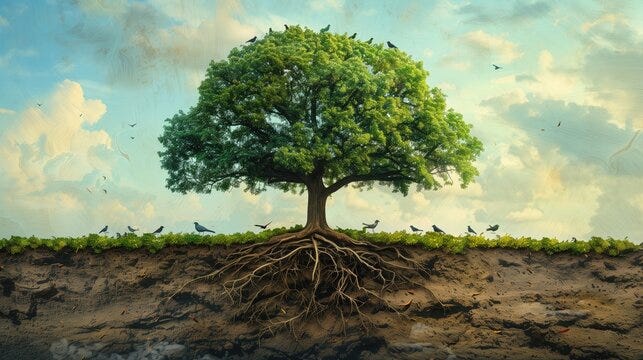
“Faith Like a Mustard Seed Tree”
(Matthew 13:31–32; Mark 4:30–32; Luke 13:18–19)
Introduction: Small Beginnings, Great Endings
Jesus points to a tiny seed — a mustard seed — and says, “The kingdom of God is like this.” He refuses to dazzle us with grandeur; instead, He invites us into a mystery: the smallest seed, planted in the ground, growing into something far larger than its beginnings could ever predict, a place where birds perch and nest in safety. In a world that worships the spectacular, the Savior centers us on the small, the hidden, the patient, the steady.
This is not just a parable about seeds; it’s a parable about faith — faith that receives the King and His kingdom; faith that looks small in your hand yet changes everything when surrendered to God. “Faith like a mustard seed” is not a license to stay small; it is a promise that God grows what we plant in obedience. The seed looks insignificant compared to the soil, and your prayer may feel insignificant compared to your problem. But in the kingdom, God does the heavy lifting. Our part is to trust, to sow, and to wait; His part is to give the increase.
The Parable in Three Voices
All three Synoptic Gospels record the parable:
- Matthew 13:31–32 places the mustard seed among other “kingdom” parables, emphasizing that though it is the smallest of seeds sown by the farmer, it becomes the largest of garden plants and a tree-like shrub, so birds come and nest in its branches.
- Mark 4:30–32 highlights the contrast between small beginning and great end, stressing that it “puts out large branches.”
- Luke 13:18–19 sets the scene in a synagogue context of resistance and surprise: the kingdom looks unimpressive but grows irresistibly into a sheltering presence.
In each retelling, the same pattern emerges: small seed → planted → surprising growth → hospitable branches. The point is not botanical trivia but theological truth: God’s reign starts small, grows quietly, and ends up larger than anyone expected.
A Word on the “Mustard Tree”
In ordinary fields, mustard is an herb that can become a tall, bushy plant — large enough for birds to land and for its branches to feel “tree-like.” Jesus’ audience would have understood: what seems insignificant becomes unexpectedly dominant. Here He’s painting an image of divine disproportion — the outsized results of trusting God with something small.
Why Mustard? The Theology of the Tiny
- The scandal of the small: God loves to begin in ways that offend our love of spectacle. A Bethlehem manger. Twelve ordinary disciples. A crucified Messiah. A mustard seed. The kingdom advances not by swords or slogans but by Spirit and seed — a Word planted in receptive hearts.
- The certainty of growth: Seeds do what seeds do — when sown, they germinate by design. In the same way, the Word of the kingdom has power in itself. It is “living and active,” and when planted, it works, often invisibly, until it becomes visible.
- The surprise of scale: Mustard doesn’t stay tiny. Kingdom faith refuses to remain a private sentiment. It unfolds into public fruit — acts of mercy, reconciled relationships, justice in the streets, hospitality at the table, families healed.
- The purpose of hospitality: The parable doesn’t stop at size; it ends at shelter. The goal of growth is not ego or pride but refuge: “the birds of the air come and nest in its branches.” Kingdom faith produces space for others — especially the weary, the wandering, the wounded.
Faith Like a Mustard Seed: Not Quantity but Direction
Jesus elsewhere says, “If you have faith like a mustard seed, you can say to this mountain, ‘Move’…” (cf. Matt. 17:20). He doesn’t congratulate large faith; He dignifies real faith — faith directed at the right object. A tiny seed in the right soil becomes a tree-like shrub. A tiny prayer directed at the living God moves what is immovable. What matters is not how impressive your faith looks to you or to others; what matters is who holds your faith and where you plant it.
- Not quantity but surrender: The power is not in the seed’s bravado; it is in its yielding — its willingness to be buried, to disappear in the earth so it can bear its destined fruit. Faith stops insisting on visibility and chooses obedient hiddenness.
- Not hype but hope: Mustard-seed faith refuses to measure God by the size of our present. It hopes against hope, trusting that what God begins, He will complete.
- Not passivity but planting: “Like a mustard seed” is not an excuse to do nothing. The farmer sows. The seed is placed in soil. Faith acts — prays, forgives, plans, serves, gives, risks — because it trusts God to grow what it cannot control.
The Soil of the Heart: Where Seeds Become Trees
Jesus has already told us about soils — the path, rocky ground, thorny ground, and good soil (Matt. 13:1–23). The mustard-seed parable assumes we have learned to prepare the heart. You can hold a seed your whole life and never see a branch. Seeds must be planted.
- Break up the ground: Repentance is the plow. Pride compacts; confession loosens. When we repent, we admit we are not yet what we should be, and the soil receives the Word again with freshness.
- Pull the thorns: Anxiety, deceit of riches, and desires for other things choke the Word. Mustard-seed faith makes space — simplifies schedules, cuts distracted habits, says “no” to lesser loves — to guard the seed God has given.
- Water with prayer: The seed is God’s Word; prayer is the early morning dew. Pray small, specific prayers over the seed: “Lord, grow patience in me”; “Lord, draw my neighbor to Yourself”; “Lord, make our church a shelter for the broken.”
- Protect with community: Gardens flourish with gardeners. Do not plant alone. Body of Christ and Christian community provides trellises for climbing virtues, fences against discouragement, and tools for patient weeding.
The Tree and the Birds: A Kingdom for the Nations
The image of birds nesting in branches echoes Old Testament pictures of great trees sheltering the nations (e.g., Ezekiel 17; 31; Daniel 4). Jesus takes that imperial imagery and transfigures it. The kingdom is not like a cedar of proud empires but like a mustard plant born from a tiny seed. Still, nations will find shelter in its branches. That is the gospel’s logic: cruciform power — power shaped by the cross — welcomes the world.
- From Israel to the ends of the earth: The early church looked small — an upper room in Jerusalem — but grew into a global family. Mustard-seed beginnings; Spirit-grown branches.
- From your life to your street: The parable is not only global; it’s personal and local. When God grows faith in you, others find rest. Co-workers perch in your patience. Children nest in your gentleness. Neighbors warm themselves at your table. Your faith becomes their refuge.
The Process: How Mustard-Seed Faith Grows
- Plant the seed of the Word: Read, hear, meditate. Let the promises of God sink below the surface-level anxieties. When you can’t feel growth, keep planting.
- Choose ordinary faithfulness: Seeds do not sprint; they settle. Keep showing up — Fellowship meetings, weekday prayer, small acts of service. Growth is a slow miracle wrapped in plain days.
- Embrace hidden seasons: The seed disappears before it reappears. There will be stretches when nothing looks different. Trust the Rootmaker. If you are planted, you are becoming.
- Welcome pruning: Growth that matters is often growth that hurts. God lays His wisdom-knife at branches that bear fruit, not to destroy them but to make them more fruitful. Pruning is His commitment to your future flourishing.
- Expect disproportionate outcomes: Do not despise the day of small beginnings. One invitation, one note of forgiveness, one simple meal — God multiplies mustard seeds.
Obstacles to Mustard-Seed Faith
- Comparison: We look at someone else’s branches and resent our seed. God whispers, “Plant what is in your hand; I will grow what I intend.”
- Impatience: We want trees overnight. God gives roots first. If you could see what He is strengthening beneath the surface, you would bless the delay.
- Control: Faith releases outcomes. Our assignment is sowing, watering, watching; God assigns the harvest.
- Cynicism: The world trains us to distrust hope. But the kingdom’s engine is resurrection. Seeds crack; lives rise.
What Mustard-Seed Faith Looks Like in Real Life
- In prayer: Every morning, surrendering your day to God — small seed. Over months and years, your inner landscape changes, and others shelter in your steadiness.
- In reconciliation: One apology, one step toward the person you hurt or who hurt you — small seed. It grows into a story of grace your children will learn from.
- In mission: Inviting a neighbor to dinner and to fellowship with body of Christ — small seed. A new sister or brother in Christ perches in your friendship and finds a home in the kingdom.
- In generosity: Quietly increasing your giving by a small percentage — small seed. Over time, your heart detaches from fear, and your resources become branches for others.
- In calling: Offering your work to God each day — small seed. He grows craftsmanship, integrity, influence. Colleagues find shade beneath your reliability.
- In suffering: Whispering “Jesus, I trust You” through tears — small seed. The Spirit grows perseverance and hope; others navigating their storms see your branches and rest.
The Patience of the Farmer and the Promise of the King
Jesus anchors our confidence not in our pace but in His promise. He is the Lord of the harvest. He knows where we have sown in tears. He knows how long winter feels. He knows the exact moment when the sprout will break the surface. The farmer does not tug at the seed to make it grow faster; he trusts the nature of what’s been planted. In the kingdom, the “nature” of what’s planted is the living Word of God — and it cannot return empty.
So take courage:
- When your prayers feel small, keep planting.
- When your repentance feels repetitive, keep weeding.
- When your service feels unnoticed, keep watering.
- When your hope feels fragile, keep watching.
- The King has promised: what He sows, He grows.
A Closing Vision: Your Life as a Living Parable
Imagine your life a decade from now if you plant one mustard seed each day. Imagine the quiet accretion of grace — roots deepening, branches widening. Imagine the unexpected guests who find rest among your leaves: a teenager who needed a listener, a neighbor who needed a family, a co-worker who needed a model of integrity, a widow who needed a ride, a skeptic who needed a patient friend. Imagine your home as a small chapter in the larger story of the kingdom — a shelter that signals the presence of the King. That is not fantasy; that is mustard-seed faith.
Reflection and Response
- Where is God inviting you to plant a small seed today? Name it and do it.
- What “thorns” need pulling so the planted Word is not choked? Name one concrete distraction to lay aside this week.
- Who could perch in your branches? Identify one person to invite into your life or to serve in a practical way.
- How will you water the seed? Choose a simple rhythm — Scripture, prayer, community — and commit to it for the next 30 days.
Take heart. In the kingdom of God, tiny is not trivial. In His hands, the smallest seed becomes a tree, and the smallest faith becomes a life that shelters many. Plant what He has given you. God will do the rest.
Prayer
Father, You delight to begin with small things and bring them to a beautiful end. Plant Your Word in our hearts today. Give us faith like a mustard seed — humble, yeilded, surrendered. Teach us to sow, to wait, to welcome. Make our lives into shelter for others, into branches for the weary, and into a garden of Your grace. We trust You to give the growth, through Jesus Christ our Lord. Amen.