
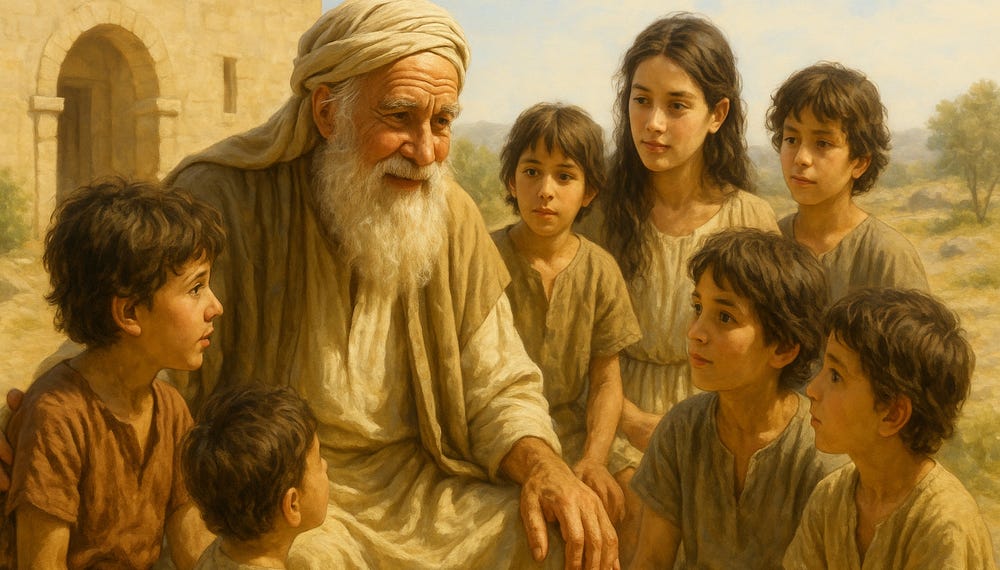
Many Christians and Jews still think of Abraham mainly in terms of bloodline, ethnicity, genealogy, circumcision, and national heritage. They think that to belong to Abraham is primarily a matter of natural descent, physical connection, or outward identity. But the New Testament opens a greater mystery and reveals a deeper fulfillment in Christ. It teaches that Abraham’s truest children are not merely those who descend from him according to the flesh, but those who share his faith. The gospel does not deny Abraham’s place in redemptive history; rather, it reveals the full meaning of the promise given to him. Abraham was called before the law was given through Moses, and he was declared righteous before circumcision was established as a covenant sign. God was already showing from the beginning that righteousness would come by faith and that His saving purpose would reach beyond one ethnic boundary.
This is why Paul speaks so strongly in Galatians and Romans about faith, promise, and inheritance. He wants believers to understand that in Christ, God has formed a people whose identity is rooted in grace rather than ancestry, in promise rather than flesh, and in faith rather than works of law. Those who belong to Christ are Abraham’s seed and heirs according to promise. Those who walk in the footsteps of Abraham’s faith are counted among his children. Those who trust in Jesus Christ become part of the household of God. Under the New Covenant, the question is no longer, “From whom are you physically descended?” but rather, “Do you belong to Christ by faith?”
Abraham’s true children are identified by faith, not by flesh
Scripture says, “Understand, then, that those who have faith are children of Abraham” (Galatians 3:7). This verse does not leave room for confusion, because it shifts the discussion from biology to belief, from physical inheritance to spiritual likeness. Paul is interpreting the Abrahamic promise in the light of Christ and showing that the defining mark of Abraham’s family is faith. Abraham himself believed God, and that faith was counted to him as righteousness. Genesis 15:6 says, “Abram believed the LORD, and he credited it to him as righteousness.” That means Abraham’s covenant standing before God began with faith, not with ritual, lineage, or performance. Romans 4:3 repeats this same truth: “Abraham believed God, and it was credited to him as righteousness.” The Spirit of God is emphasizing that the beginning point of Abraham’s relationship with God was trust in divine promise. Therefore, those who share Abraham’s trust share Abraham’s spiritual family line. This is why Jesus confronted those who boasted in physical descent but lacked Abraham’s spiritual character. In John 8:39, when some said, “Abraham is our father,” Jesus answered, “If you were Abraham’s children, then you would do what Abraham did.” Their physical claim could not replace spiritual reality. In the sight of God, the children of Abraham are not merely those who can trace ancestry, but those who reflect Abraham’s faith-filled response to God.
The New Testament insists that belonging to Abraham is more than an external badge. Romans 9:6–8 helps us here: “For not all who are descended from Israel are Israel. Nor because they are his descendants are they all Abraham’s children… It is not the children by physical descent who are God’s children, but it is the children of the promise who are regarded as Abraham’s offspring.” Under the New Covenant, God is not building His family on genetics but on grace. He is not creating a people by fleshly succession but by spiritual rebirth. This should humble the proud and comfort the outsider. The proud cannot boast, because no one earns entrance into Abraham’s family by blood or achievement. The outsider can rejoice, because faith in Christ is enough to be welcomed into the promise. The world asks about race, heritage, culture, and status. God asks whether there is faith in His Son.
Abraham was justified before circumcision, so he could become the father of all who believe
The New Testament teaches that Abraham was declared righteous before he received circumcision, and this order is central to the gospel. Romans 4:10 asks, “Under what circumstances was it credited? Was it after he was circumcised, or before? It was not after, but before!” Abraham did not become righteous because he was circumcised; he was circumcised after he had already been counted righteous through faith. Romans 4:11 continues, “And he received circumcision as a sign, a seal of the righteousness that he had by faith while he was still uncircumcised.” Circumcision was a sign, not the source. It was a seal, not the substance. It testified to a righteousness already received, not a righteousness newly earned. This is why Paul can then say that Abraham is “the father of all who believe but have not been circumcised, in order that righteousness might be credited to them” (Romans 4:11). God arranged the story of Abraham in such a way that the father of the faithful could include both Jew and Gentile in the scope of promise. The timing itself was prophetic. Before the law, before Sinai, before national Israel was formed, God justified a man by faith. In doing so, He laid the foundation for a gospel that would be proclaimed to all nations. Abraham’s life was not only historical; it was also revelatory. God was already preaching beforehand the truth that justification would come by faith and not by external ordinance.
It means that no outward mark, ceremony, or religious heritage can replace the necessity of faith. Baptism is precious, but baptism does not justify apart from Christ. Church membership has value, but it cannot reconcile the soul to God. Christian family background may be a mercy, but it does not make one righteous. Only faith in Jesus Christ unites the sinner to the righteousness of God. This is precisely why Romans 4:12 says Abraham is father not only of the circumcised, but of those “who also follow in the footsteps of the faith that our father Abraham had before he was circumcised.” Under the New Covenant, we are not invited to imitate Abraham’s external signs, but his inward trust. Colossians 2:11–12 points to the greater fulfillment in Christ: “In him you were also circumcised with a circumcision not performed by human hands… having been buried with him in baptism, in which you were also raised with him through your faith in the working of God.” All who believe in Christ, whether circumcised or uncircumcised, whether near or far, whether Jew or Gentile, may call Abraham father in the sense intended by the gospel. So also now, salvation is not born from outward religion but from trust in the crucified and risen Christ.
In Christ there is one family of Abraham beyond every earthly division
The gospel does not merely add Gentiles into a separate category of blessed outsiders. It creates one new people in Christ, one family of faith, one household of promise, one spiritual seed of Abraham. Galatians 3:26–28 says, “So in Christ Jesus you are all children of God through faith… There is neither Jew nor Gentile, neither slave nor free, nor is there male and female, for you are all one in Christ Jesus.” This does not erase the earthly distinctions that exist in creation or history, but it does declare that none of those distinctions define covenant status in Christ. Before God, the ground is level at the foot of the cross. The same faith unites all believers to the same Lord. The same Spirit indwells all the redeemed. The same righteousness clothes every child of God. The same promise belongs to all who are in Christ. Ephesians 2:14–16 says of Jesus, “For he himself is our peace, who has made the two groups one and has destroyed the barrier… His purpose was to create in himself one new humanity out of the two.” The dividing wall has been broken down in Christ. The old categories that produced hostility, pride, separation, and exclusion no longer define the people of God. Those who were once far and those who were near are now brought together in one body through the cross. This is a new-creation brought forth by the blood of Christ. Abraham’s family under the New Covenant is not a fragmented collection of competing identities, but a united people formed in Christ.
If all who belong to Christ are Abraham’s seed, then every true believer is family. That means the church must not rebuild walls that Christ has torn down. We must not boast over one another according to culture, ethnicity, religious pedigree, or outward advantage. Romans 10:12 says, “For there is no difference between Jew and Gentile — the same Lord is Lord of all and richly blesses all who call on him.” The Lord is one, the call is one, the salvation is one, and the family is one. 1 Corinthians 12:13 also says, “For we were all baptized by one Spirit so as to form one body — whether Jews or Gentiles, slave or free.” The New Covenant family is Spirit-formed, Christ-centered, and grace-defined. The church therefore is not a social club for the religiously familiar, nor a tribal gathering for those of common background. It is the household of faith, the temple of the Spirit, and the body of Christ. This should produce humility, love, patience, and holy unity among believers. No one enters because he deserves to. No one is excluded because of earthly origin. Every believer stands by grace alone. Every believer is welcomed through the same cross. Every believer drinks from the same Spirit. Therefore, when we speak of Abraham’s children, we are speaking of a people that God Himself has gathered from every tribe, language, people, and nation.
To be Abraham’s children means to walk in the faith and obedience that flowed from Abraham’s trust in God
The New Testament does not teach a dead, empty, merely verbal faith. When it says that believers are Abraham’s children, it means they participate in the kind of living trust that Abraham himself displayed. Romans 4:12 speaks of those “who also follow in the footsteps of the faith that our father Abraham had.” Abraham’s faith was not a slogan; it was a life of trusting God’s word, leaving familiar ground, waiting for what he could not yet see, and obeying when God called. Hebrews 11:8 says, “By faith Abraham, when called to go to a place he would later receive as his inheritance, obeyed and went.” Faith moved him. Faith separated him from old securities. Faith caused him to journey as a pilgrim. Hebrews 11:10 says he was “looking forward to the city with foundations, whose architect and builder is God.” Abraham’s faith was forward-looking, promise-centered, and heaven-minded. James 2:21–23 also reminds us that Abraham’s faith was demonstrated in action, saying, “You see that his faith and his actions were working together, and his faith was made complete by what he did.” This does not mean Abraham earned righteousness by works; rather, it means true faith reveals itself in obedient response. A living root bears visible fruit. Thus, Abraham’s children are not merely people who agree with a doctrine about faith; they are people in whom that faith becomes visible through trust, obedience, endurance, and surrender.
Many want inheritance without surrender, blessing without obedience, and spiritual status without spiritual transformation. But the children of Abraham are those who not only speak of faith, but live by faith. Jesus said in John 8:39, “If you were Abraham’s children, then you would do what Abraham did.” He was not teaching justification by works, but exposing false claims that lacked spiritual reality. Abraham believed God. Abraham obeyed God. Abraham left behind what God called him to leave. Abraham hoped against hope. Abraham trusted the Lord even when the promise seemed delayed. So also now, the children of Abraham are those who trust Christ when the world offers visible alternatives. They are those who obey the word of God even when it costs them comfort. They are those who live as strangers and pilgrims on the earth, because they seek a better country. Hebrews 11:13 says of the faithful, “They admitted that they were foreigners and strangers on earth.” This was true of Abraham, and it must also be true of us. Being Abraham’s child is not merely about receiving a title. It is about sharing a spiritual pattern. It is about trusting God’s promise more than visible circumstances. It is about obeying God because one believes Him. It is about walking by faith and not by sight. Under the New Covenant, the children of Abraham are recognized not by circumcision in the flesh but by faith that works through love, endures in hope, and obeys from the heart.
Conclusion
The New Covenant reveals with clarity and power that Abraham’s children are defined by faith in Christ. Abraham was justified by faith before circumcision so that he might become the father of all who believe. The promise given to Abraham finds its fulfillment in Christ, the true Seed. All who belong to Christ, whether Jew or Gentile, are one family, one body, one people of promise. The true children of Abraham walk in the faith of Abraham, not merely in the memory of his name. And all who are in Christ are heirs according to the promise of God.
Therefore, let no one boast in the flesh. Let no one place confidence in ancestry, ritual, tradition, or religious appearance. Let no one imagine that outward identity can replace living faith in the Son of God.
If you are in Christ, then you are not outside the covenant mercy of God. You are not second-class in the household of faith. You are Abraham’s seed and an heir according to promise. Walk then as a child of faith. Live as one who belongs to the family of promise. Love the brethren as fellow heirs. Set your hope on the eternal inheritance. And glorify God, who has taken people from every nation and made them one in His Son.