
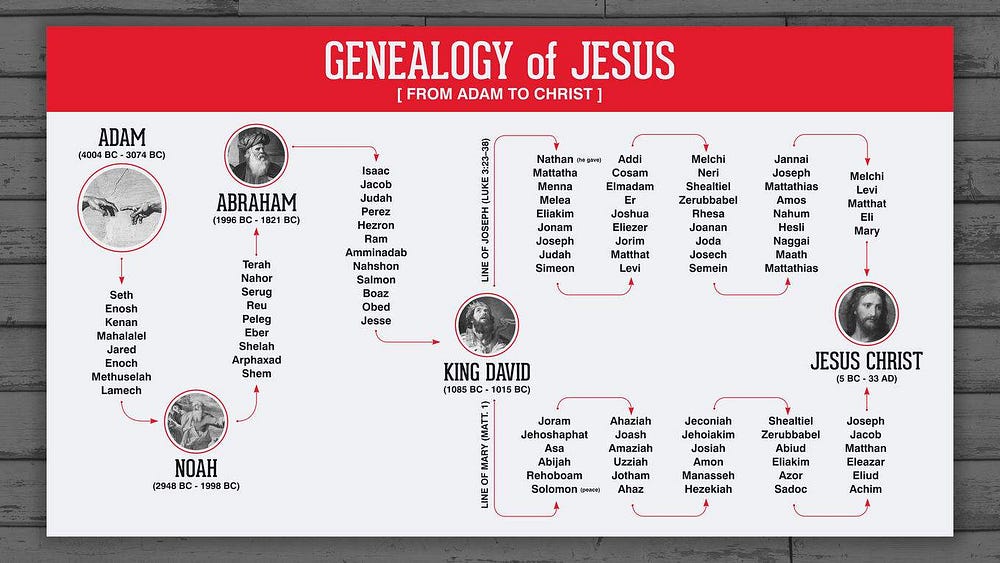
The genealogy of Jesus in Matthew 1 is not merely a list of names. It is a testimony. It is a proclamation that God writes redemption into human history, even when that history is stained with sin, sorrow, shame, scandal, exile, and unexpected turns. In Israel, genealogies generally centered on men. They traced fathers, sons, tribes, inheritance, and covenant lines through the male household. Yet Matthew, under the inspiration of the Holy Spirit, breaks expectation by naming women in the royal line of Messiah. Before Mary, he includes Tamar, Rahab, Ruth, and Bathsheba, though Bathsheba is mentioned indirectly as “the wife of Uriah.” Then the genealogy reaches in Mary, the virgin mother of Jesus Christ.
These women are not included because they fit the pattern of honor according to human standards. They are included because God’s grace overrules human pride. Their lives carry pain, irregularity, reproach, and outsider status. Some were widows. Some were connected to sexual scandal. Some were Gentiles. Some suffered because of the sins of men. Some lived in morally dark surroundings. Yet God did not erase them from His redemptive plan. He placed them in the line that led to Christ. Advent invites us to look backward and forward. We look backward at how God prepared the way for the coming of His Son through real history and real people. We look forward to the fullness of redemption that Christ brings to all who trust in Him.
Tamar: Hope Through Righteous Appeal
Tamar’s story is found in Genesis 38, and it is one of the most startling narratives in Scripture. At first glance, it appears to be a story of shame and irregularity, but on closer reading it becomes a story of injustice exposed and covenant hope preserved. Tamar was married into Judah’s family. Her husband Er died, and according to the custom later reflected in levirate responsibility, the family line was to be continued through the brother. Yet Tamar was denied justice. Judah failed to fulfill his responsibility toward her. She was left childless, vulnerable, and set aside, though she had a rightful claim within the covenant family. In desperation, Tamar disguised herself and conceived by (father-in-law) Judah himself.
Genesis 38:26 is the turning point: “Then Judah identified them and said, ‘She is more righteous than I, since I did not give her to my son Shelah.’” This statement is astonishing. Tamar is not called sinless, but she is declared more righteous than Judah because the greater guilt lay with the one who denied justice. Her action arose within a context of oppression, exclusion, and broken family responsibility. Genesis 38:27–30 records the birth of Perez and Zerah, and Matthew 1:3 names Perez in the line of Christ. That means the Messiah’s genealogy openly includes a moment of painful irregularity, not to glorify sin, but to glorify the God who preserves His promise in spite of human failure. Ruth 4:12 later shows Tamar remembered in Israel not only as a scandal, but as a woman through whom a house was built. The elders bless Boaz and Ruth by invoking the house of Perez, whom Tamar bore to Judah.
Tamar’s previous life was marked by widowhood, frustration, blocked hope, and male neglect. Her later life was marked by vindication through the birth of sons who became part of the covenant line. She begins in silence and marginalization, but ends in remembrance. She begins as one denied a place, but ends as one whose son stands in the ancestry of the Messiah. There is hope in Tamar’s story because God saw what others ignored. God did not allow injustice to erase her from His plan. In a world where women were often vulnerable within family and legal structures, Tamar’s inclusion in Jesus’ genealogy says that God remembers the wronged. He sees the one pushed aside. He hears the cry of the neglected.
Rahab: Peace Through Faith
Rahab enters the biblical story in Joshua 2 as a Canaanite woman in Jericho, a city under judgment. She is identified as a prostitute. By every external measure, she is an outsider to Israel’s covenant privileges. She belonged to a condemned city. She lived among idolaters. She carried a social identity associated with shame. Yet into that setting the fear of the Lord entered her heart. When the Israelite spies came, Rahab hid them and confessed a remarkable faith. Joshua 2:11 records her words: “for the Lord your God, he is God in the heavens above and on the earth beneath.” This is more than fear of military defeat. This is confession. She had heard what God did at the Red Sea and to Israel’s enemies, and she recognized His sovereignty. She turned from identifying with Jericho to identifying with the people of God.
Rahab’s story is one of peace found through faith in the midst of impending judgment. Joshua 2:12–14 shows her seeking mercy not only for herself but for her household. She asks for a true sign, and the scarlet cord becomes the visible token of her deliverance. Joshua 6:25 says, “But Rahab the prostitute and her father’s household and all who belonged to her, Joshua saved alive.” She passed from a doomed city into the congregation of Israel. Hebrews 11:31 honors her faith: “By faith Rahab the prostitute did not perish with those who were disobedient.” James 2:25 also speaks of her works as evidence of living faith. Then Matthew 1:5 reveals that she became the mother of Boaz. What a transformation. From Jericho to Israel, from prostitution to covenant inclusion, from a house of shame to the ancestry of the Messiah. Grace did not merely spare her. Grace gave her a future.
Rahab’s previous life was bound to the old order of Canaan. Her later life was joined to the covenant people and ultimately to the messianic line. Scripture does not romanticize her past, but neither does it define her only by that past. Instead, the Word of God defines her by faith. A guilty person can be reconciled to God through faith. An outsider can be brought near. Ephesians 2:13 says, “But now in Christ Jesus you who once were far off have been brought near by the blood of Christ.” That truth is foreshadowed in Rahab. She was far off. She was outside. Yet by faith she came under mercy.
Ruth: Joy Through Covenant Loyalty
Ruth’s story is one of the most tender and beautiful in Scripture, yet it begins in bereavement. She was a Moabite woman, a widow, and a foreigner. Her husband died. Her father-in-law died. Naomi, her mother-in-law, was left bitter and emptied by sorrow. Ruth could have returned permanently to Moab and resumed life among her own people. Instead, she chose covenant loyalty. Ruth 1:16–17 contains one of the most moving confessions in the Bible: “Your people shall be my people, and your God my God.” This is not merely affection for Naomi. It is faith expressed through faithful attachment. Ruth turned from Moab’s gods and cast herself upon the God of Israel. Her path ahead held uncertainty, poverty, and vulnerability, yet she walked it in loyalty and trust.
Ruth’s ancestry according to Moab’s origin in Genesis 19 carries a dark memory, since Moab descended from Lot’s incestuous union with his elder daughter. The Moabites stood on the edges of Israel’s story often as adversaries and strangers. Yet God’s grace reaches where human memory remembers only disgrace. Ruth did not choose her ancestry, but she did choose the God of Israel. In Bethlehem she gleaned in the field of Boaz, and the Lord’s providence quietly arranged every step. Ruth 2:12 records Boaz’s blessing: “The Lord repay you for what you have done… under whose wings you have come to take refuge.” Later Boaz acts as kinsman-redeemer. Ruth 4:13–17 recounts her marriage, the birth of Obed, and Naomi’s restored joy. Ruth 4:17 then says, “He was the father of Jesse, the father of David.” Matthew 1:5 places Ruth directly in the line of Christ.
Ruth’s previous life was marked by widowhood, foreignness, and the shadow of a troubled national origin. Her later life was marked by covenant inclusion, marriage, fruitfulness, and participation in the royal line. Her story is joy after bitterness. Naomi said, “I went away full, and the Lord has brought me back empty,” yet by the end the women say that Ruth is better to Naomi than seven sons. God turned mourning into a harvest of mercy. Ruth lived in ordinary faithfulness without seeing the full scope of God’s plan, yet her small acts of loyalty were woven into the history of David and finally of Christ. Joy is often born not in sudden triumph, but in steadfast obedience through grief.
Bathsheba: Love That Redeems Ruin
Matthew does not name Bathsheba directly. He calls her “the wife of Uriah.” This wording is deliberate and powerful. It forces the reader to remember the sin of David. Bathsheba’s story in 2 Samuel 11–12 is not primarily a romance; it is a story of abuse of power, adultery, betrayal, and murder. David saw Bathsheba, took her, and when she conceived, he arranged the death of Uriah, her husband. Bathsheba suffered within a royal scandal created by the king’s sin. The text does not present her as the aggressor. Rather, she appears as one caught in the destructive reach of David’s authority. Matthew keeps Uriah in view to remind us that the royal line itself was morally compromised. Even David, the great king, needed mercy. The Messiah would not come as a continuation of human royal virtue, but as the holy answer to human royal failure.
Yet Bathsheba’s story does not end at 2 Samuel 11. After the death of the child conceived in sin, David comforted Bathsheba, and she later bore Solomon. 2 Samuel 12:24–25 says, “and the Lord loved him and sent a message by Nathan the prophet. So he called his name Jedidiah, because of the Lord.” Grace entered the ruins. This did not erase the seriousness of David’s sin. The sword remained in his house, and the consequences were real. But God was not finished. In 1 Kings 1, Bathsheba also appears as a significant royal mother involved in the securing of Solomon’s succession. She moved from being a violated and bereaved woman to one who held honorable influence in the kingdom. Matthew 1:6 includes her in Jesus’ line, but in a way that preserves memory of wrong done to Uriah. Grace does not deny history. It redeems in the truth.
Bathsheba’s previous life in the biblical record is marked by sorrow, exposure, and grief. Her later life includes motherhood, royal significance, and a place in the line of the promised King. Her story is complex because it carries both tragedy and restoration. This is precisely why it belongs in the genealogy of Jesus. The Messiah came into a line where men sinned grievously, women suffered deeply, and yet God’s covenant mercy continued. Psalm 51, born out of David’s repentance, shows that where sin is confessed, mercy can be found. Bathsheba’s presence in the genealogy witnesses that God’s love is strong enough to work through the aftermath of terrible evil, not by approving it, but by overcoming it.
Mary: Fulfillment Through Humble Faith
Mary stands at the end of the genealogy and the threshold of the incarnation. What the earlier women foreshadow, Mary receives in fullness. Tamar hoped, Rahab believed, Ruth clung, Bathsheba endured, but Mary conceived the promised Christ by the Holy Spirit. She too entered a situation that could invite misunderstanding and reproach. Before she lived with Joseph, she was found to be with child. In the eyes of society, this could appear scandalous. Yet Matthew 1:20–23 reveals the truth: “that which is conceived in her is from the Holy Spirit… they shall call his name Immanuel.” Luke 1:38 gives Mary’s response: “Behold, I am the servant of the Lord; let it be to me according to your word.” Mary is not exalted as sinless in the biblical text; rather, she is presented as humble, believing, and submissive to God’s word.
Mary’s previous life, before the annunciation, was the ordinary life of a young Jewish woman under covenant expectation. Her later life became forever bound to the mystery of the incarnation, the sorrows of discipleship, and the privilege of bearing the Messiah. She sang in Luke 1:46–55, magnifying the Lord and rejoicing in “God my Savior.” That confession matters deeply. Mary herself needed the Saviour she bore. She was blessed among women, but she was also a daughter of Adam saved by grace. Simeon later told her in Luke 2:35 that a sword would pierce her own soul also. Thus Mary’s calling included joy and pain, wonder and suffering. She held the infant Christ, watched Him grow, and stood near the cross where He accomplished redemption. Her story is fulfillment because in her, the promise reaches embodiment. The Word became flesh.
Conclusion: The Gospel Written in a Genealogy
The women in Jesus’ genealogy teach us that God’s redemptive history is wider, deeper, and more gracious than human religion often expects. Tamar shows hope when justice is denied. Rahab shows peace through faith for the outsider. Ruth shows joy through covenant loyalty and redemption. Bathsheba shows love that works even through ruin and sorrow. Mary shows fulfillment in humble submission to God’s saving purpose. Together they testify that the Messiah did not come from a line of untarnished heroes, but through a history where God’s grace kept breaking in. That is why sinners should not despair. If the genealogy of Jesus contains such stories, then the gospel is surely for the broken, the ashamed, the displaced, the wounded, and the waiting.
In the kingdom of God, those often overlooked by men are seen and remembered by the Lord. And in the New Covenant, this reaches its fullness. Galatians 3:28 declares that in Christ there is neither male nor female as grounds of spiritual privilege, for all are one in Him. The genealogy does not erase earthly distinctions, but it proclaims heavenly grace over them.
Jesus Christ is the center of this genealogy and the meaning of every name in it. He is greater than Judah, David, Solomon, and every ancestor before Him. He is the holy Son born into an unholy human line in order to make sinners holy. He is the Redeemer for Tamar’s cry, Rahab’s refuge, Ruth’s longing, Bathsheba’s wounds, and Mary’s faith. He is the Saviour of the world. Therefore let every believer read Matthew 1 not as a dry list, but as a gospel proclamation. Grace has a history. Mercy has a lineage. Redemption has entered the world. And the lesson for us is clear: no life is too tangled for God’s purpose, no past too dark for His mercy, and no outsider too far to be brought near through Jesus Christ our Lord.
3 thoughts on “Grace in the Genealogy: The Women Who Prepared the Way for Jesus”
Your post is so clear in that in shows believers like myself to accept the unloved, the downtrodden and actually all peoples who I meet daily in my comings and goings. My parents taught me to love all peoples regardless of their state of life. We are all equal at the foot of the Cross.
Thank you for reminding me that, ” no past too dark for His mercy”.
Love is not a secondary virtue in the New Covenant; it is the very life and nature of Christ formed in those who truly know Him. A person may speak great theology, exercise spiritual gifts, and appear outwardly powerful, but if he does not love God with all his heart, love his brothers and sisters in Christ, and love his neighbor in need, he only proves that Christ is not truly reigning in him. Under the New Covenant, love is not merely a command to admire, but the clearest evidence that one has been born of God and abides in Christ.
Amen!!